
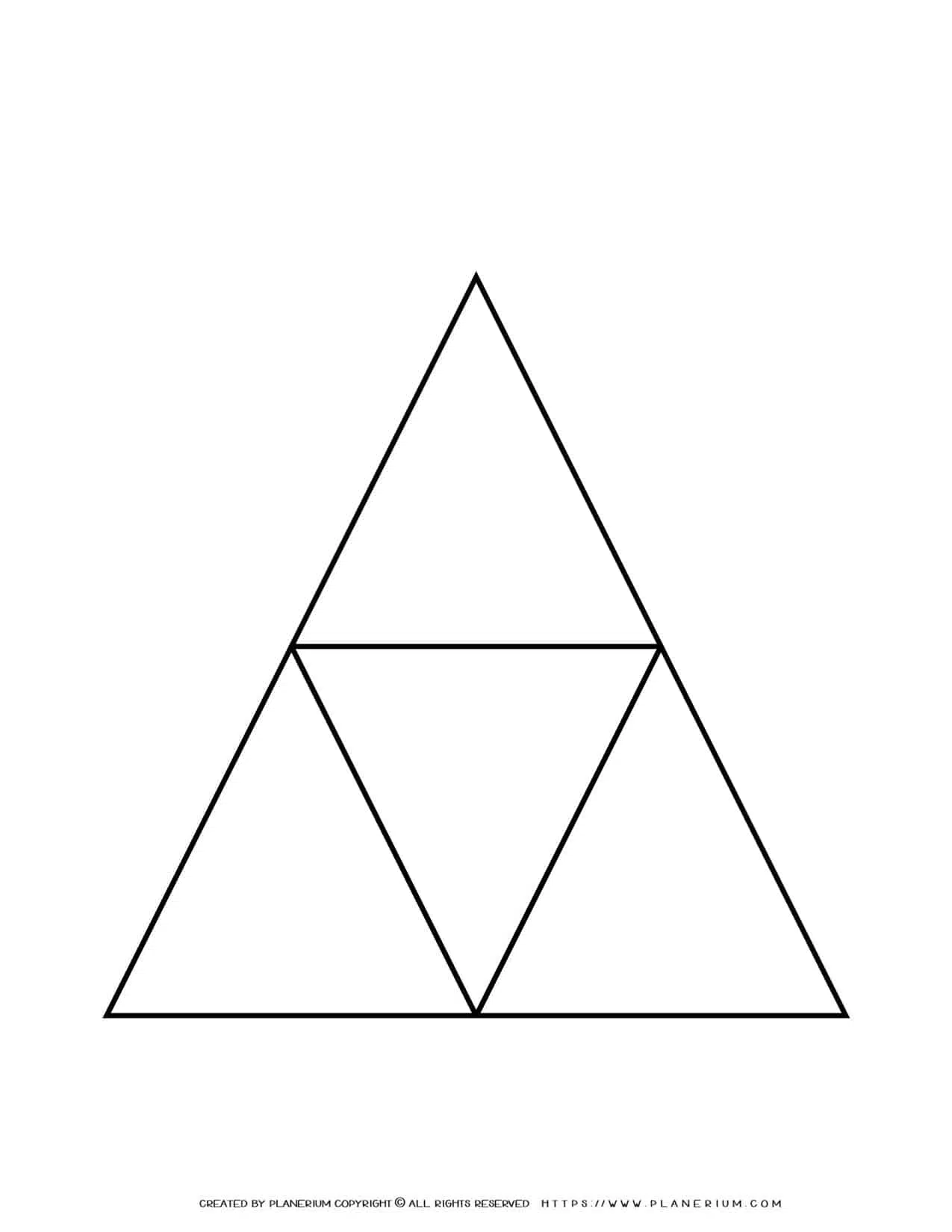
Graphic Organizer – Triangle Diagram
1400
Views
35
Prints
8
Saves
Free printable 4-part triangle graphic organizer for connecting three related ideas with a central concept, shared feature, conclusion, or key takeaway. A flexible visual thinking template for Grades 3-6.
4-Part Triangle Graphic Organizer – Free Printable
This free printable triangle graphic organizer helps students organize three related ideas around one central concept.
The template includes a large triangle divided into four sections: three outer triangles and one inverted triangle in the center. This structure makes it useful for showing relationships between three categories, examples, ideas, or characteristics and connecting them to one shared conclusion or main idea.
Students can use keywords, short sentences, symbols, or drawings in each section.
Classroom Ideas
Use this printable triangle organizer to help students:
- Organize three supporting ideas around one central concept
- Compare three examples and identify what they share
- Record three characteristics and a main conclusion
- Connect three causes to one effect
- Organize three pieces of evidence around a claim
- Compare three characters, places, objects, or concepts
- Sort information into three categories and summarize the relationship
- Plan three supporting points for a writing activity
- Organize three research findings and one key takeaway
Suggested Grade Levels
This graphic organizer is especially useful for Grades 3-6.
Because the layout asks students to understand relationships between several sections, it is best suited to learners who can already organize information beyond a simple list or sequence.
Teachers can add headings or short prompts before printing to make the task clearer.
How Can Students Use the Four Sections?
The three outer triangles can represent:
- Three ideas
- Three examples
- Three categories
- Three characteristics
- Three causes
- Three pieces of evidence
The center triangle can then be used for:
- A shared feature
- A conclusion
- A main idea
- A connection
- A key takeaway
- A final response
This makes the organizer useful when students need to move from separate pieces of information toward a more connected understanding.
Ideas Across Subjects
Language Arts:
Use the three outer sections for supporting details, evidence, or character traits and the center for the main idea or conclusion.
Science:
Compare three organisms, materials, processes, or characteristics and use the center to record a shared feature or scientific conclusion.
Social Studies:
Organize three events, people, places, or cultural characteristics and use the center to identify an important connection.
Writing:
Plan three supporting points in the outer sections and place the main claim or concluding idea in the center.
Research:
Record three findings or sources around the outside and summarize the key takeaway in the center.
Explore More Graphic Organizers
Explore the full Graphic Organizer Templates collection for more free comparison charts, story maps, sequence organizers, and visual thinking templates.
You may also find these layouts useful:
- 3-Circle Venn Diagram – useful for comparing three topics and identifying shared characteristics.
- Blank Three-Column Chart – useful for sorting information into three open categories.
- 3-Column 6-Row Chart – useful for structured comparison across three categories.
- Five-Section Graphic Organizer with Headline – useful for organizing one main topic into several supporting ideas.
FAQ
What is a triangle graphic organizer used for?
It helps students organize three related ideas, examples, categories, or pieces of evidence and connect them to one central concept or conclusion.
What should students write in the center triangle?
The center can contain a main idea, shared feature, conclusion, key connection, or final takeaway.
What grade levels is this printable suitable for?
It is especially useful for Grades 3-6 because students need to understand relationships between several pieces of information.
Can this organizer be used for compare-and-contrast activities?
Yes. Students can place three topics in the outer sections and use the center to record an important similarity or connection.
Can it be used for writing activities?
Yes. The three outer triangles can hold supporting points or evidence, while the center can contain the main claim or concluding idea.
Can students draw instead of write?
Yes. Each section can contain drawings, symbols, keywords, or short written responses.