
Hanukkah, a significant Jewish holiday commemorating an event that transpired two millennia ago, holds a rich historical and cultural significance that is both intriguing and educational. Delve into the captivating story of Hanukkah, exploring its traditions, culinary delights, and the depth of its celebratory customs. In this comprehensive guide curated especially for educators and teachers, unlock a wealth of free and paid teaching resources tailored for kindergarten and elementary school levels, providing a holistic understanding of this festive occasion. Discover the magic of Hanukkah and enrich your classroom with its timeless teachings and enduring traditions.

Table Of Contents
What is Hanukkah?
Hanukkah is a Jewish lights festival, celebrated for eight consecutive days.
The meaning of Hanukkah in Hebrew is “Dedication.” That’s why this holiday is also called The Feast of Dedication. Hanukkah doesn’t appear in the Jewish bible, “Torah” but does appear in the First Book of Maccabees.

When is Hanukkah celebrated?
Hanukkah is celebrated between the end of November and late December.
In the Hebrew Calendar, it is on the 25th of Kislev.
Hanukkah dates for 10 Years
2025 – December 14 – December 22
2026 – December 4 – December 12
2027 – December 24 – January 1
2028 – December 12 – December 20
2029 – December 1 – December 9
2030 – December 20 – December 28
2031 – December 9 – December 17
2032 – November 27 – December 5
2033 – December 16 – December 24
2034 – December 6 – December 14
2035 – December 25 – January 2
Hanukkah Story
The story of Hanukkah begins with the reign of Alexander the Great in the years 356BC – 323BC. Alexander ruled over Syria, Egypt, and Palestine, yet enabled the lands under his control to keep their faiths and retain a certain degree of autonomy. In the first 160 years after the quiet takeover of Judea by Alexander the Great, the Hellenistic Greeks gradually allowed their cultural influence to take over the Jewish population. The urban elite of Jerusalem has adopted the Greek language, their clothes, and their manners, including the pursuit of sports, an unfamiliar game for them until then.


While the military has always appreciated physical strength and combat skills, the Greeks have made it a purpose in itself, creating competitions where the fastest / strongest / most talented have been honored. They built a sports stadium south of the Temple in Jerusalem, where young Jews, including priests, competed.
The Greek culture was modern, enlightened, scientific, and universal, while Judaism was recognized as outdated, tribal, and restrictive.
At that time, adopting the Greek lifestyle was a precondition for material success and cultural progress. As Paul Johnson, the historian wrote: “Acceptance of Greek culture was a passport to upper-class citizenship, as would later be Christianity” [A History of the Jews].
Needless to say, not all Jews were in favor of this lifestyle, as long as they were allowed to continue to study and keep the Torah, they accepted the Greek rule.
All this changed in 167 BC when the Greek King Antiochus IV Epiphanes forbade the observance and the study of the Torah. Violating this rule entailed the death penalty.

Greek army forces entered the village of Modi’in, ordering residents to sacrifice a pig to a Greek idol’s statue. Although it was a forbidden act for Jews, a Greek Jew got up from the same city and wanted to do it anyway.
As he was about to raise the pig sacrifice, Matityahu stabbed him with his sword and killed the Greek inspiration. After the explanation, he turns to the audience and announces: “Who among you fears the Lord, and who is the Lord to me!” – Everyone who fears the word of God who will stand by my side and fight.

Those who join Matityahu and his five sons – Judah, Eleazar, John, Jonathan, and Simon – make their way towards the mountains, assuming the Greeks return to take revenge on the city. In the mountains, they organize a guerrilla army, appointed mainly by his son, Judah. Yehuda wins the title “Maccabi,” which means “the hammer” (Macbeth), and which later became a ‘Warriors’ slogan at that time.


We do not know the size of the Maccabean army, but the most optimistic estimate does not exceed 12,000 men. This tiny force goes into battle against a Greek army with 40,000 warriors!
In addition to numerical superiority, the Greeks were professional warriors – they had equipment, were well trained, and had a herd of war elephants at their disposal, which constituted the tanks of the ancient world.
The Jews, on the other hand, were significantly inferior in number, barely trained, and equipped, but what they lacked in training and equipment was made up for by their resilience.
Most of the battles occur at the foot of the mountains leading from the coastal plain to Jerusalem. The Greeks try to march their forces up the wadis leading to the mountain area, but in vain. The roads from the lowlands to the mountain are limited, and only at some points can the Greeks make their way upwards. These were the places where the Maccabees chose to ambush and attack them.
Nowadays, when we read the Maccabees’ story, it seems that these are short events, which took place over several weeks, but in practice, it was a matter of twenty-five years of warfare and many casualties for both sides.
After the first three years since the revolt began, the Jews succeeded in reconquering Jerusalem. They find a filthy and corrupt temple, which has become a place where pigs are sacrificed on its altar. When they return to the temple, the first thing they do is light a replacement Menorah (after the Greeks melted down the actual Menorah).


But unfortunately, there was only one small jug of oil, which was still sealed with the High Priest’s special seal. They use this oil to light the lamp, and miraculously, it was enough for eight days until fresh oil was sent to the temple.
The Maccabees purify the temple and ordain it on the 25th of Kislev – the Hebrew date for the beginning of the eight days of Hanukkah’s holiday.

Hanukkah commemorates two types of miracles:
- The victory of the few and weak Jews over the Greeks.
- The spiritual victory of Jewish values over those of the Greeks.
Hanukkah Traditions
- Each day of the eight days of Hanukkah, candles are lit on the Hanukkah menorah (Hanukkiah).
- Reciting three prayers
- Singing Hanukkah special songs
- Eating treats fried in oil, such as Latkes and Sufganiyot.
- Giving children Hanukkah gelt
- Playing with a four-sided Dreidel
Hanukkah Menorah
Hanukkah menorah, also called Hanukkiah, is a candelabra designed especially for the Hanukkah candlelight ritual. The Hanukkah menorah contains places for a total of nine candles, one for every evening, plus the “shamash” or the assistant candlelight.
Menorah is the Hebrew word for a lamp.
It mainly describes the seven-branched candlestick utilized in the old Temple in Jerusalem. Therefore, a hanukkiah, or Hanukkah menorah, is a menorah. Every Hanukkiah is a menorah, but not every menorah is a hanukkiah.


Hanukkah Menorahs can be made from any non-flammable materials. They are also available in a wide range of sizes and shapes. Lighting the candles is Hanukkah’s most central ritual. One candle burned each night of the eight-night holiday till it is ablaze with light on the 8th night.
Hanukkah candles
During Hanukkah, on each of the eight evenings, candles are lit in a ‘Hanukkiah.’ There is a special ninth candle called the ‘shamash’ or servant candle, which is used to light the other candles. The ‘Shammash’ is often in the center of the other candle lights and has a more significant position.
On the first evening, one candlelight. On the second evening, two candles are lit until the eighth evening, when all eight candles burn. When lighting the candles, there are three prayers to recite:
-
- “L’hadlik Ner” – To light a candle – A general blessing over candles.
- “She-asah Nisim” – Thanking God for making miracles to our ancestors.
- “She-Hekhianu” – Thanking God for reaching this day of the year.
- Hanukkah Candles should burn for at least half an hour. The Hanukkah menorah is placed in the front home window of residences so people passing can see the lights and keep in mind Hanukkah’s tale.
How to light the Hanukkiah?
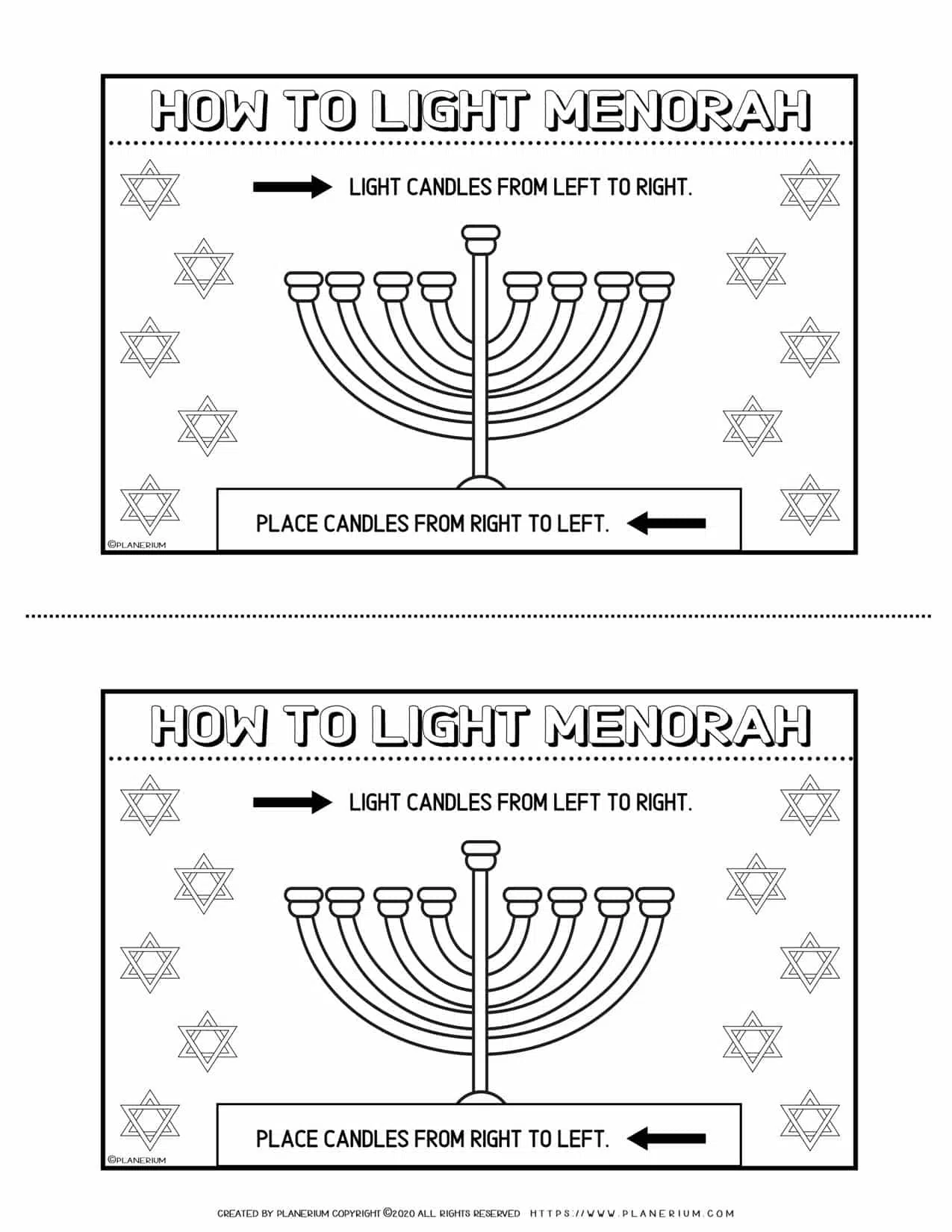
You place the candles from right to left and light them using the Shamash, from left to right. The menorah candles must not be used for any purpose other than lighting the menorah, and you light the candles only with the Shamash.
To fulfill all eight nights with burning candlelights, you need 44 candles:
First evening – One candle and one Shamash – Two
Second evening – Two candles and one Shamash Three
Third evening – Three candles and one Shamash Four
Fourth evening – Four candles and one Shamash Five
Fifth evening – Five candles and one Shamash Six
Sixth evening – Six candles and one Shamash Seven
Seventh evening – Seven candles and one Shamash Eight
Eighth evening – Eight candles and one Shamash Nine
2+3+4+5+6+7+8+9 = 44
Hanukkah Foods
Potato Pancakes

Latkes or Potato pancakes are shallow-fried pancakes.
You make these tasty pancakes from grated potato and a binding component such as egg or applesauce, with grated garlic or onion and some flavoring. The meal is occasionally made from mashed potatoes to make pancake-shaped croquettes.
The Hebrew name of one latke is “Leviva.”
Most latkes are crispy little potato pancakes that are served with apple sauce or sour cream during the eight days of Hanukkah.
The reason for eating Hanukkah’s latkes is to commemorate the miracle of the oil lasting eight days and nights in the holy temple.
If you wish to make the delicious potato pancakes by yourself, we found this step-by-step and easy recipe on how to make latkes at home.
Brisket

Brisket is a part of beef from the bust or lower breast.
If you plan to prepare the Brisket yourself, then keep reading to understand how to treat this part of the meat.
The brisket muscle mass includes the surface and the deep bust.
Since cattle don’t have collar bones, this muscle mass supports 60% of the cattle’s body weight. Thus, it requires a considerable amount of connective tissue, so this meat must be prepared correctly to soften it.
To make a good brisket, you need a slow cooking technique. Here is an excellent recipe for a slow cooker beef brisket with BBQ sauce.
Kugel

Kugel is a Jewish dish made of noodles, eggs, dairy fat, such as butter, cheese, and sugar. Although the kugel is very simple to make, there are many variations of it. As soon as you start with one and like it, you can develop your style and unique taste. Here is one classic Jerusalem Kugel you can’t fail with.
Sufganiyot

Sufganiyah is one of Hanukkah’s most well-known signs in terms of traditional food, and if you haven’t eaten one yet, when you do, you’ll understand all the buzz.
Sufganiyah is a round jelly doughnut consumed in Israel and worldwide on the Jewish festival of Hanukkah. The doughnut is deep-fried in oil, full of jam or custard, and then topped with powdered sugar. The doughnut recipe came from Europe in the 1500s, and by the 1800s was called a Berliner in Germany. Polish Jews called it a “Ponchik,” fried the doughnut in schmaltz rather than fat because of kashrut laws. Polish Jewish immigrants brought the “Ponchik” to Israel. Then it is called “Sufganiyah” based on the Talmud’s description of “Spongy dough.”
Want to make Sufganiyah by yourself? Then check out this recipe.
Chocolate Babka

A babka is a sweet, knotted bread or cake that originated from the Jewish communities in Poland and Ukraine. Today, it is popular in Israel and other parts of the Jewish diaspora.
Preparing the babka requires a yeast-leavened dough that is rolled out and spread, then filled with chocolate, cinnamon, fruit, or cheese. In the end, it is rolled up and braided before baking.
If you’re not afraid of playing with yeast, follow this recipe, and you’ll get excellent results. For a non-dairy version, try replacing the butter with high-quality coconut oil. Click here to get it.
Hanukkah Colors
The typical colors of Hanukkah are Black, white, yellow, gold, silver, and blue.
Black represents the dark periods that Jews had to go through before the rededication of the Second Temple. White represents peace, Yellow represents the light, gold and silver represent merit.
Blue and white were Judah’s colors, where white represented the peace and blue the heavens. Blue is related to the skies, reality, ingenuity, and belief. Blue and white Hanukkah candles are also popular in different locations.
Hanukkah For Kids
Welcome to the enchanting world of Hanukkah for Kids, where learning and fun intertwine to illuminate the joy of this cherished Jewish holiday. Here at Planerium, we are dedicated to providing a wealth of engaging and educational resources designed specifically for young minds eager to explore the magic of Hanukkah. Dive into our carefully curated collection of activities, stories, and interactive materials, tailored to captivate and educate children of all ages. Let us guide you on a journey through the rich traditions, fascinating tales, and meaningful customs of Hanukkah, making learning an exciting adventure for every young learner.
🕎 Hanukkah Mini Book for Kids

Delight young learners with our 30-page coloring booklet! Covering Hanukkah’s essence and traditions, this compact PDF booklet (4.85×7.37 inches) is perfect for lower primary grades. Let kids color bolded terms as they learn about Hanukkah’s significance. Choose from 14 activity pages and get ready for a fun, interactive learning experience—all you need are scissors, a stapler, paints, and pencils. Download now and spark the joy of Hanukkah exploration!
Hanukkah Gelt
Hanukkah gelt refers to money given as presents throughout Hanukkah. It is typically offered to youngsters and sometimes educators, commonly combined with the game of Dreidel.
In the 20th century, sweet suppliers started offering Hanukkah-themed delicious chocolate “coins” covered in gold or silver foil, as a replacement or addition to real coin gifts.


Hanukkah Dreidel
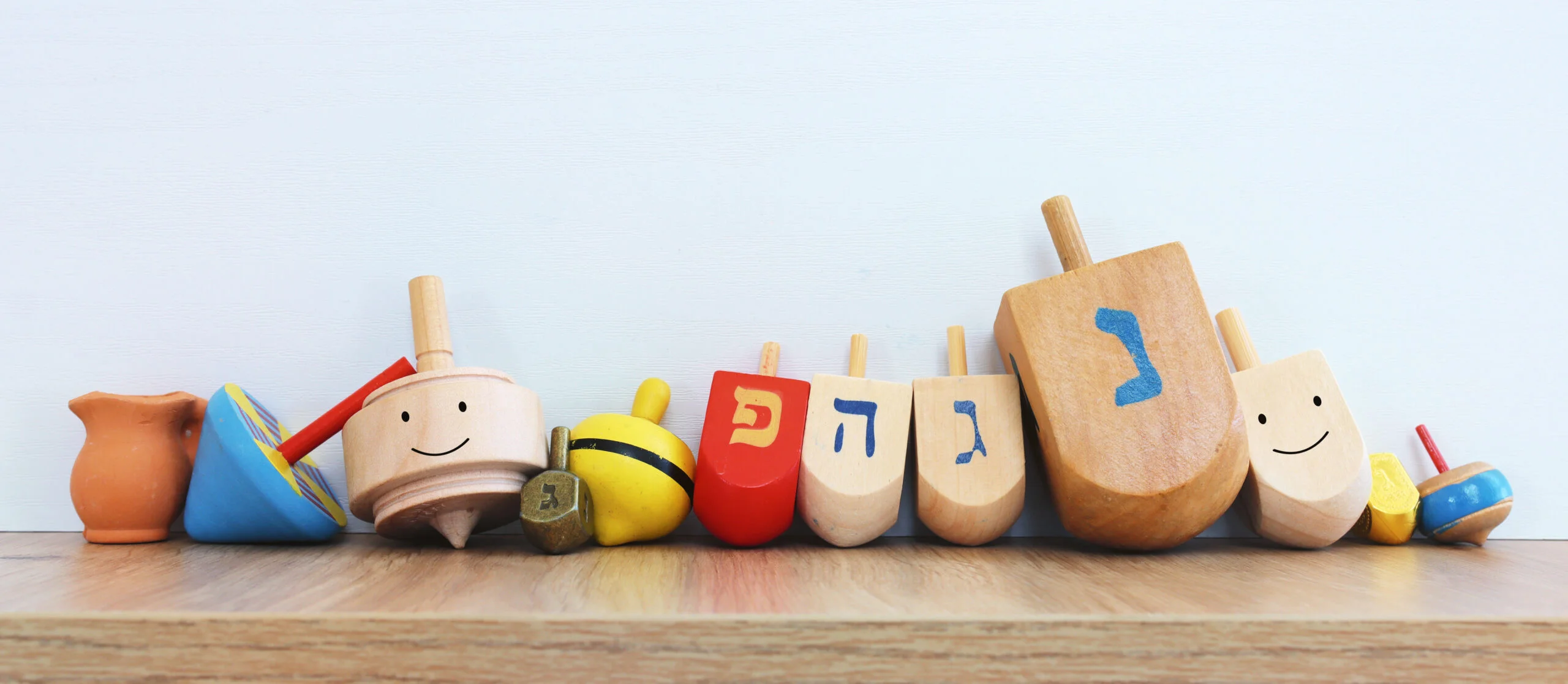
A dreidel is a pointed, four-sided spinning top that rotates on its tapered base. Dreidels are typically made of plastic or wood. The name in Hebrew is pronounced “Sevivon,” which comes from the word “Turn” in Hebrew.
Hanukkah’s story tells us that dreidels date back to the Greek-Syrian ruling days, which ignited the Maccabean revolt that ended in the Hanukkah miracle.
Studying the Torah during these days was considered a crime penalized by death. The Jewish kids had to hide in caves to learn, and when a Greek patrol would approach, the kids would pull out their dreidels and pretend to be playing.
What is the meaning of each letter on the dreidel?
In Hebrew, each side of the dreidel has a different letter with a specific meaning:
• The letter ‘Nun’ (נ) stands for ‘Nes’ – Miracle.
• The letter ‘Gimel’ (ג) stands for ‘Gadol’ – Large.
• The letter ‘Hae’ (ה) stands for ‘Hayah’ – Was.
• The letter ‘Peh’ (פ) stands for ‘Poh’ – Here. (For those residing inside Israel)
• The letter ‘Shin’ (ש) stands for ‘Sham’ – There. (For those resides outside Israel)


Combine all letters, and you’ll get “Nes Gadol Hayah Sham,” meaning a great miracle occurred there, or a great miracle happened here for those residing inside Israel.
How to Play Dreidel
Preparations:
• You need at least two players
• Each player gets 10 gelts
• Each player gives 1 gelt to a shared pot
The first player spins the Dreidel and follows the rules for each letter the Dreidel falls.
* In the Yiddish language, the letters have different meanings to serve the rules of the game.
• The letter ‘Nun’ (נ) stands for ‘Nisht’ – Nothing >> Do nothing.
• The letter ‘Gimel’ (ג) stands for ‘Gantz’ – Everything. >> You get everything.
• The letter ‘Hae’ (ה) stands for ‘Helb’ – Half. >> You win half the pot.
• The letter ‘Shin’ (ש) stands for ‘ Shtel’ – Put In. >> You give back one gelt.
(The ‘Peh’ holds the same meaning in Israel)
Whenever the pot gets empty, all players must contribute one gelt.
Any player who cannot contribute gelts must leave the game.
The winner is the one who’s left alone, where all the other players cannot contribute any gelt.
How to Make a Dreidel?
If you want an enjoyable craft activity for your kids, let them build and design their dreidels. We created these two dreidel templates, especially for easy cut and glue, one with the letter “Pey” and the other with the letter “Shin.” Click the images for Free Prints!


Hanukkah Coloring Pages for Kids
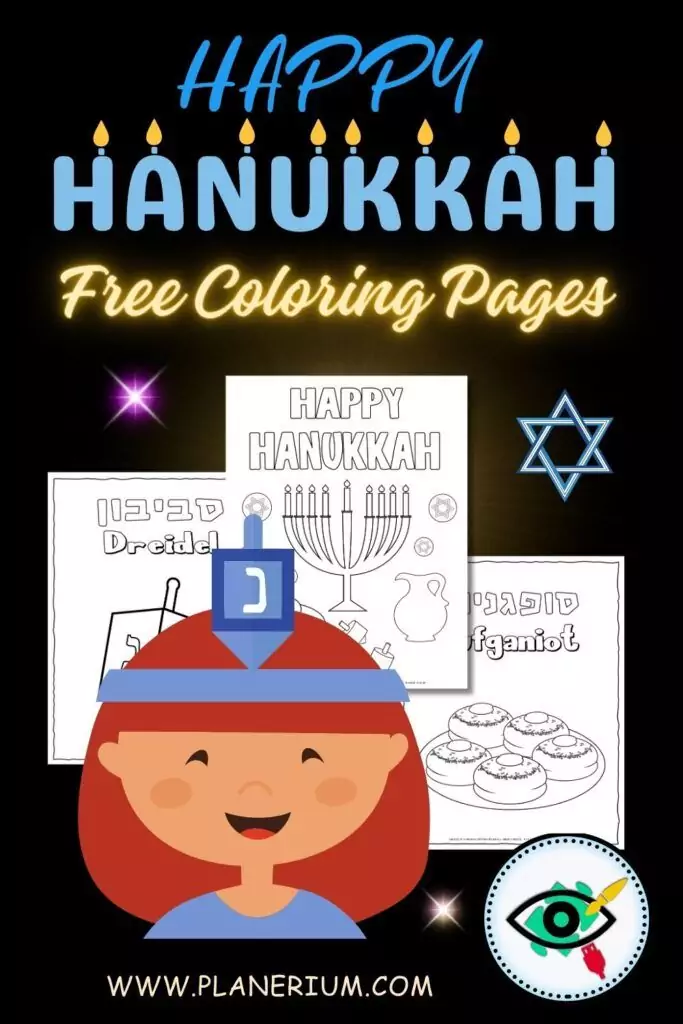
Welcome to Planerium’s Hanukkah extravaganza! Engage your young learners in the joyous festival of lights with our meticulously crafted Hanukkah coloring pages. From dreidels to Hanukkah menorahs, our free printables offer a perfect blend of fun and education, allowing children to explore the rich traditions of Hanukkah while fostering their creativity. Whether in the classroom or at home, these coloring pages are a fantastic way to infuse the spirit of the festival into your child’s world.
Tips for Classroom/Home Use:
- Encourage discussions about the significance of each symbol depicted in the coloring pages.
- Display finished coloring pages to create a vibrant Hanukkah-themed classroom or home environment.
See more >
Hanukkah Coloring Pack:
Unleash Creativity and Learning!
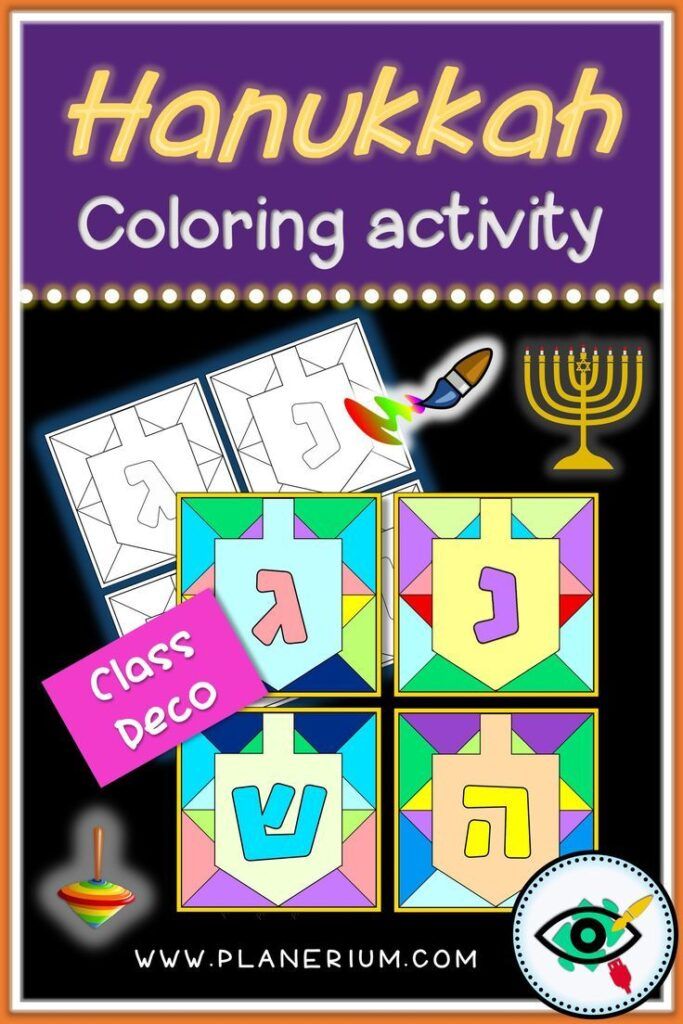
Ignite the festive spirit with our Hanukkah Pack, featuring 10 captivating coloring pages and worksheets! Tailored for elementary school students in grades 3-6, whether in schools or homeschooling environments, these engaging activities are sure to inspire creativity and learning.
Hanukkah Worksheets For Kids
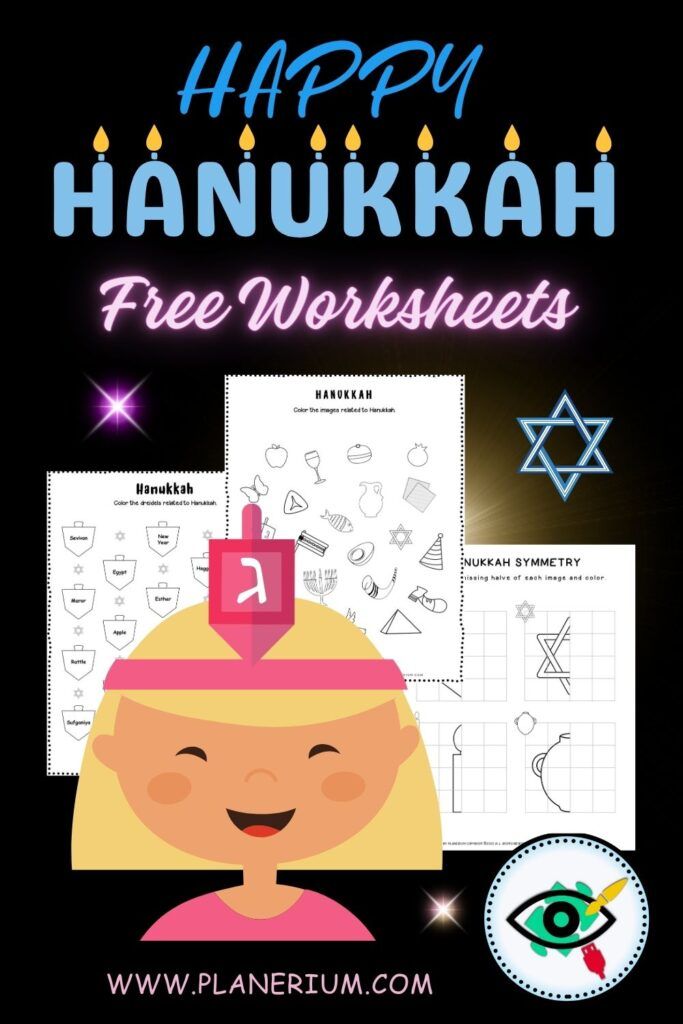
Join us in celebrating the festival of lights with our thoughtfully curated Hanukkah worksheets! These comprehensive, free resources are designed to spark curiosity and deepen understanding of Hanukkah traditions among young learners. From learning about the history behind this festive occasion to exploring the customs associated with it, our worksheets are a valuable addition to your teaching or parenting arsenal.
Tips for Classroom/Home Use:
- Use the worksheets as a prelude to discussions on cultural diversity and religious tolerance.
- Incorporate creative activities that reinforce the concepts covered in the worksheets, fostering a holistic understanding of the holiday.
See more >
Fun Hanukkah Activity Pages For Kids
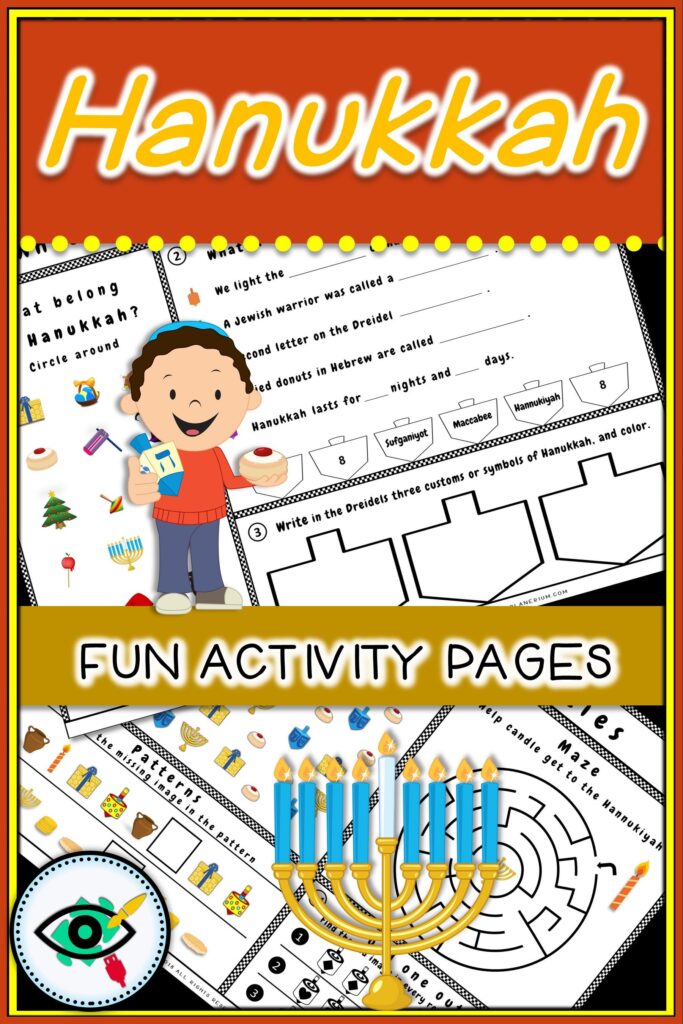
Get 18 engaging activities compacted to save paper and costs, perfect for grades 1-3. Enjoy coloring pages, crafts, and a variety of educational activities like word games, math challenges, and more! All you need are colors and scissors to start the fun. Perfect for Hanukkah Candle Lighting nights!
Hanukkah Games
Get ready to immerse yourself in the vibrant festivities of Hanukkah with Planerium’s exciting array of printable games! From engaging memory games to stimulating sudoku and captivating word searches, our collection offers a delightful blend of entertainment and education. With these interactive activities, children can revel in the joy of the holiday while honing their cognitive skills and expanding their knowledge of Hanukkah traditions. Dive into the celebration and make learning a playful adventure with our Hanukkah game printables!
Tips for Classroom/Home Use:
- Integrate these games into your lesson plans to reinforce Hanukkah-related concepts in a fun and interactive manner.
- Host a Hanukkah game night at home, inviting friends and family to partake in the festive spirit while bonding over these enjoyable activities. Dive into the celebration and make learning a playful adventure with our Hanukkah game printables!”
See more >
Hanukkah Memory Game: Explore and Learn with Fun!

Discover the holiday’s symbols with our vibrant memory game! Choose from 3 sets of cards or mix them up for endless fun. With 72 pieces of 2.3×2.3 inch cards, this PDF game is suitable for all ages. Just print, cut, and play! For lasting use, print on cardstock or laminate. Instructions included. 🌟🔍🃏
Hanukkah Templates

Unleash your creativity this Hanukkah with our versatile Hanukkah templates! Designed to inspire artistic expression and encourage hands-on learning, our free printables provide a platform for children to craft their own unique Hanukkah decorations and artworks. Whether it’s designing personalized greeting cards or constructing intricate paper dreidels, our templates are a delightful way to infuse the festive spirit into your classroom or home.
Tips for Classroom/Home Use:
- Arrange a Hanukkah crafting session where children can use the templates to create personalized decorations or gifts.
- Showcase the crafted items in a designated Hanukkah display to foster a sense of pride and accomplishment in the children.