
Planerium AI Lesson Plan
Exploring Emotions Through Creative Expression: Back to School Coloring Activity
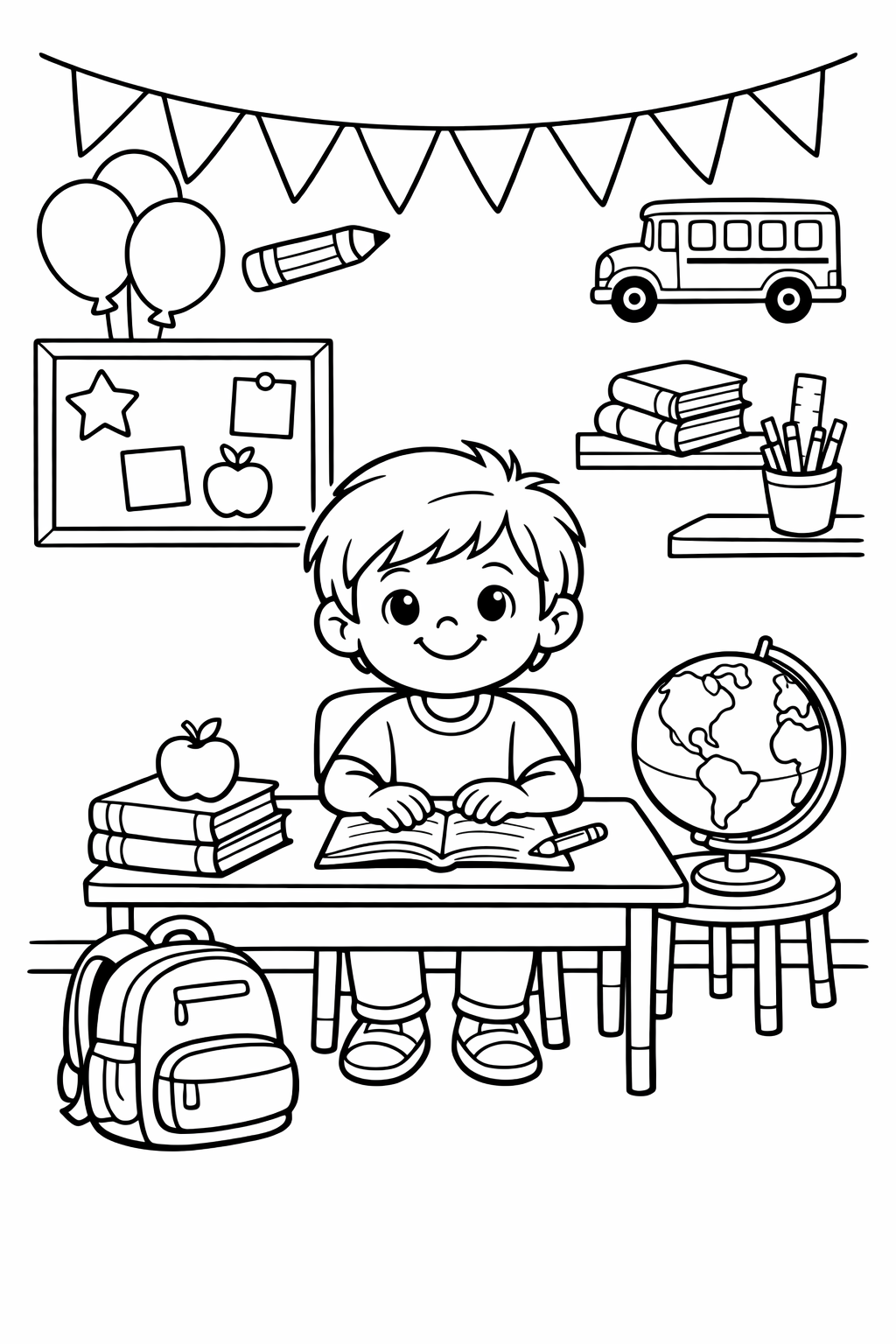
Original printable
Printable AI coloring page for Second · Simple Outline · Classroom · Back To School · Standard, with a teacher-friendly description and classroom use ideas.
Learning Objective
Students will use creative expression to identify and represent different emotions related to school through coloring and discussion.
Teacher-Selected Inputs
Why this printable fits
This printable coloring page supports the subject of Emotions by providing a fun, familiar back-to-school scene that encourages students to use colors and creativity to express how they feel about school, helping them connect emotions to their personal experiences.
Vocabulary
PRE-TEACH
- Emotion: A feeling like happy or sad.
- Expression: Showing how you feel.
- Creative: Using your imagination.
USE DURING LESSON
- Coloring
- Feelings
- Happy
- Calm
- Excited
Materials
- Back to School Fun in the Classroom coloring page
- Crayons or colored pencils
Prep
- Print enough coloring pages for each student
- Prepare a word bank card with emotion words
Lesson Steps
- Introduction12 minTeacher actions: 1. Show the coloring page to the class 2. Explain that today they will color a back-to-school picture while thinking about their feelings 3. Introduce emotion words using the word bank cardTeacher script: Let's look at this picture of a student at school. How do you think this student feels today? We are going to color and think about different feelings we might have about school.Example / model: Point to the student's smile and say, 'The student looks happy. What color would you use to show happy?',Printable use: Show entire coloring page and refer to it as students prepare to color.Move on when: Students can identify at least one emotion word from the word bank when asked.Support if needed: Use the word_bank_card to remind students of emotion words to use.
- Modeling and Guided Practice11 minTeacher actions: 1. Model coloring the student's shirt with one favorite color 2. Explain your color choice with an emotion word 3. Invite students to share a feeling and a color they would useTeacher script: I am coloring the student's shirt blue because blue makes me feel calm. What color would you choose to show how you feel about school?Example / model: Teacher colors the shirt blue and says, 'Blue means calm to me.Printable use: Color part of the printable while explaining the emotion-color connection.Move on when: Students volunteer a color and emotion word linked appropriately.Support if needed: Provide sentence frame: 'I feel ___ when I see ___, so I use ___ color.
- Independent Practice11 minTeacher actions: 1. Hand out coloring pages and crayons 2. Instruct students to color the picture expressing how they feel about school through their color choices 3. Circulate to prompt or support studentsTeacher script: Now, you will color your picture. Think about how school makes you feel and choose colors that help show that feeling.Example / model: A student colors the balloons red and says, 'Red makes me feel excited for school.Printable use: Students color the entire printable to express emotions.Move on when: Students have started coloring and can explain one color choice connected to an emotion.Support if needed: Use sentence frames or offer individual prompts to help students link colors and emotions.
- Sharing and Reflection11 minTeacher actions: 1. Invite volunteers to share their colored picture and explain some color choices 2. Reinforce emotion vocabulary and creative choices with positive feedbackTeacher script: Who would like to share how you colored your picture and what feelings you showed?Example / model: Student says, 'I colored the globe green because green makes me feel happy to learn about the world.Printable use: Students show their finished coloring page as they share.Move on when: Students can explain at least one color associated with an emotion from their coloring.Support if needed: Prompt students with questions like, 'What feeling does that color show?'}],
Formative Check
- Step: Modeling and Guided Practice
- Ask students to: Share at least one feeling word and corresponding color choice
- Look for: Student connects emotion appropriately to a color verbally or with gesture
Success Criteria
- Students can identify and use at least three emotion words to describe how colors show feelings in their coloring.
- Students can explain at least two color choices related to emotions in complete sentences using a sentence frame.
Differentiation
Support: Teacher provides a word bank card with emotion words and colors to help students choose and express feelings during coloring.
Scaffold tool: Word Bank Card
Standard: Students independently choose colors to represent their feelings and explain their choices.
Extension: Students write a short sentence describing their favorite part of the picture and how it makes them feel.
Early Finishers: Students create a short story aloud about the student in the picture using the emotions and colors they chose.
Accommodations
- Provide larger crayons or pencils for students with fine motor challenges.
- Allow students to verbally express color choices and feelings if writing is difficult.
- Provide an assigned partner to assist with color selection and discussion.
- Offer additional time to complete the coloring and sharing.
Common Misconceptions
- Students may think certain colors always mean only one feeling; emotions can be different for everyone.
- Students might focus on coloring inside the lines rather than emotional expression.
- Students may have difficulty linking abstract emotion words to concrete color choices.
Assessment
- Observe students' ability to link color choices to emotion words during discussion.
- Check for at least three emotion words used correctly in explanations.
- Listen for complete sentence use with sentence frames when describing feelings and colors.
Teacher Notes
Standards
- CCSS.ELA-LITERACY.SL.2.4: Tell a story or recount an experience with relevant details and clear event sequences.
- CCSS.ELA-LITERACY.SL.2.6: Produce complete sentences when appropriate to task and situation.
IF SHORT ON TIME
- Keep: Introduction
- Skip or shorten: Sharing and Reflection steps can be shortened or omitted to save time.
FOLLOW-UP OPTIONS
- Explore a storybook about emotions and connect colors to story feelings.
- Practice creating emotion masks and describing each emotion shown.
- Create a class emotions chart using colors and feelings from the coloring activity.
HOME CONNECTION
Ask your child to share their favorite color from the coloring page and tell you what feeling it represents.