
Planerium AI Lesson Plan
Exploring Body Parts with Outline Templates
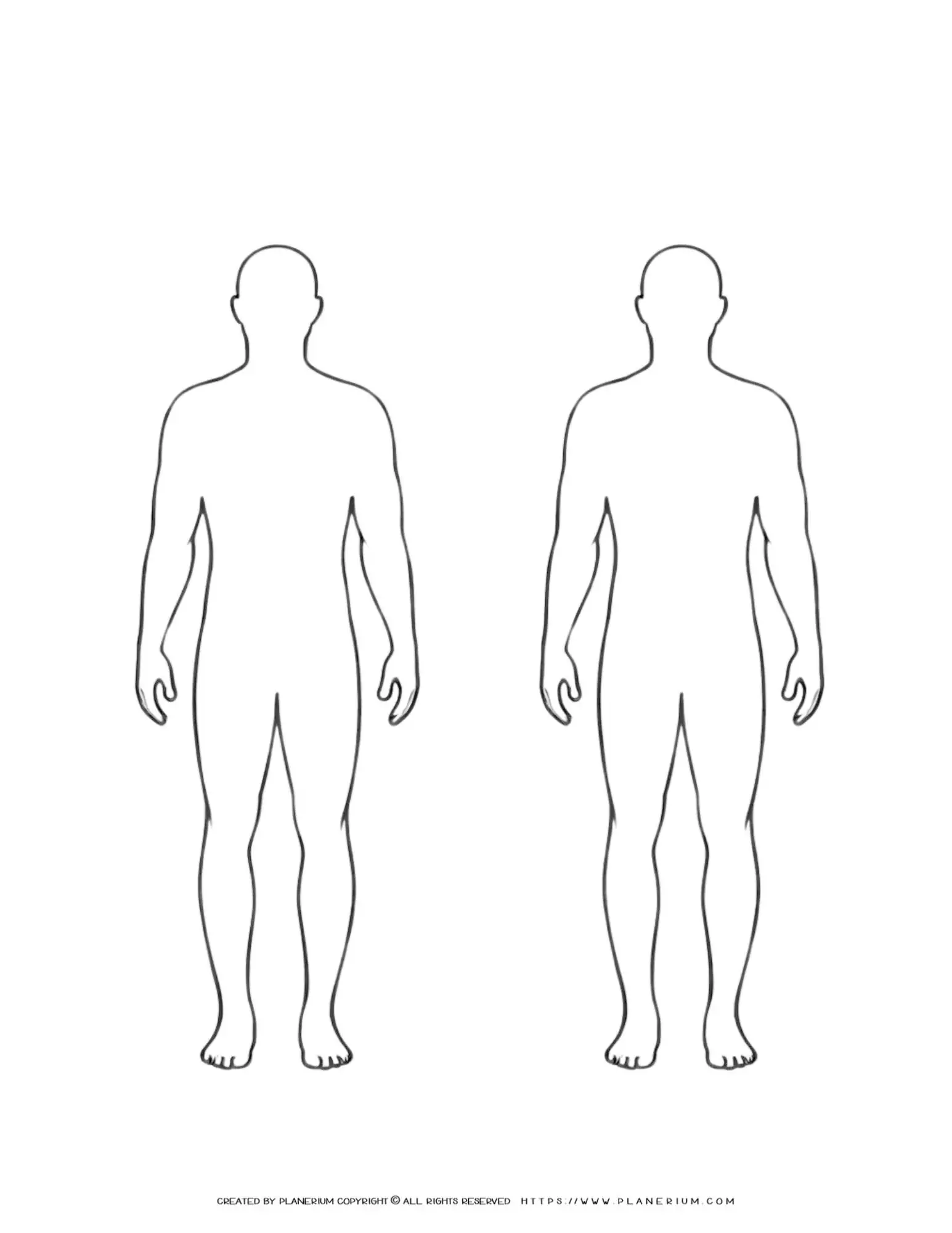
Original printable
Free printable with two male human body outline templates for body-part labeling, comparison activities, anatomy, health, art, SEL, and creative classroom projects.
Learning Objective
Students will identify and label major body parts on a provided outline template.
Teacher-Selected Inputs
Why this printable fits
The two-man human body outline printable effectively allows third graders to creatively engage with body anatomy while enhancing fine motor skills through labeling and coloring activities.
Key Vocabulary
- Head
- Arms
- Legs
- Feet
- Body systems
Prerequisite Skills
- Basic knowledge of body parts and their functions
Materials
- Two Man Human Body Outline Templates (printable)
- Colored pencils or markers
- Labels for body parts (optional)
Prep
- Print the two-man human body outline templates for each student or pair of students.
Lesson Steps
- Introduction10 minTeacher actions: Introduce the topic of body parts by discussing the importance of each part of the body. Ask students to name some body parts they already know. Write their responses on the board.Teacher script: Today, we're going to learn about our body! Who can tell me some of the parts of our bodies?Example / model: Students may say 'head', 'arms', 'legs', and 'feet'.Printable use: Introduce how the outline will help us label and learn about these parts.Move on when: Students are able to contribute at least one body part to the board.Support if needed: Prompt students who are quiet by asking leading questions like 'What helps us hold things?
- Modeling15 minTeacher actions: Show a large version of the body outline (or use an overhead projector). Demonstrate labeling one body part, such as 'Head' and coloring it. Explain why this part is important as you go along.Teacher script: Let’s label the 'head' together and color it in! Why is our head important?Example / model: The 'head' houses our brain, which helps us think and see.Printable use: Guide students in using their own outlines to follow along with the labeling and coloring.Move on when: Students are following along and seem engaged in the activity.Support if needed: Provide a labeled example for reference.
- Independent Work25 minTeacher actions: Distribute the body outline templates and art supplies. Allow students to choose 5 body parts to label and color on their outlines. Walk around and support students as needed.Teacher script: Now it's your turn! Choose five body parts to label and color on your outline.Example / model: Students may label 'arms', 'legs', 'torso', 'hands', and 'feet'.Printable use: Students will use the outline for labeling and coloring as a creative display of body knowledge.Move on when: Students are actively working on their outlines and showing understanding of body parts through labeling.Support if needed: Encourage students who struggle by suggesting they use the terms on the board as a guide.
- Sharing and Reflection10 minTeacher actions: Invite students to share their completed templates with a partner or small group. Ask them to explain why they chose the body parts they did and their functions.Teacher script: Now, let’s share what we created! Tell your partner about your favorite body part and why it's important.Example / model: A student might say, 'I like my legs because they help me run!Printable use: The outlines serve as a visual aid during sharing, allowing students to point to what they labeled.Move on when: Students are engaged in sharing and listening to each other.Support if needed: Facilitate conversation by suggesting phrases to use, such as 'I labeled this because…
- Wrap-Up5 minTeacher actions: Conclude by asking a few students to share one new thing they learned about the body. Reinforce the importance of all body parts working together.Teacher script: What is one new thing you've learned about the body today?Example / model: Students might say they learned about the function of the heart or the brain.Printable use: Reiterate how the printable helped them learn about body parts in an engaging way.Move on when: Students can summarize one new learning about body parts.Support if needed: Provide sentence starters if some students struggle to formulate their thoughts.
Checks for Understanding
- Students can correctly label at least 5 body parts on their outline.
- Students can explain the function of at least one body part they labeled.
Success Criteria
- Students successfully label and color body parts on their outlines.
- Students articulate the importance of different body parts during sharing.
Differentiation
- Provide colored templates for students who need additional support.
- Allow advanced students to add more body parts and fun facts.
Accommodations
- Offer one-on-one support for students with special needs.
- Provide a word bank of body parts for students needing visual aids.
Common Misconceptions
- Students may confuse similar body parts (e.g., knees and elbows).
- Some may overlook the body's systems (muscular, skeletal) in their explanations.
Assessment
- Observe students during sharing for understanding of body part functions.
- Review completed outlines for accurate labeling.
Extensions
- Students could create a poster of the human body using images and facts learned in this activity.
- Introduce a project on body systems, grouping related body parts together.
How to Use the Printable
- Principal usage is for labeling and coloring body parts, providing a visual representation of anatomy knowledge.
- The outlines serve as a creative project and review tool for understanding human anatomy.
Teacher Notes
- Prepare additional templates if working with larger groups.
- Monitor students during the independent work phase for engagement and understanding.