
Planerium AI Lesson Plan
Creative Self-Expression with a Male Body Outline
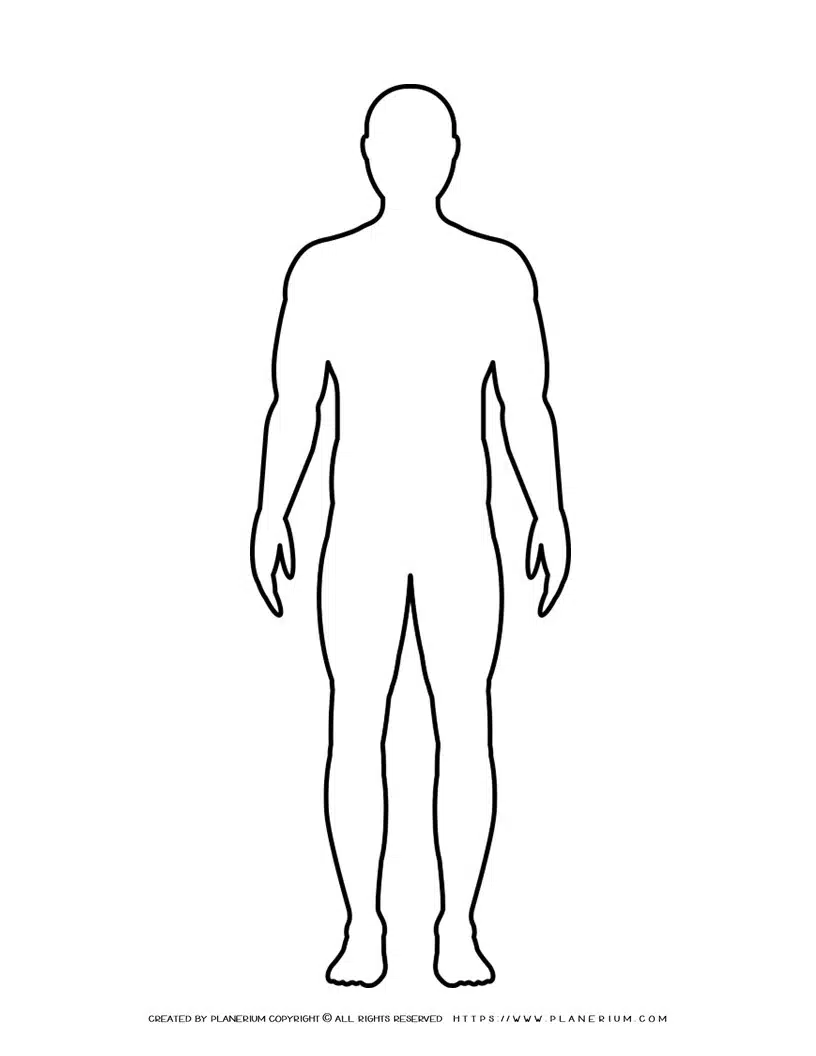
Original printable
Free printable male body outline template for human body activities, art, body awareness, character design, health lessons, and creative classroom projects.
Learning Objective
Students will use a blank male body outline to creatively express themselves by designing clothing and labeling basic body parts, building vocabulary and body-awareness skills in the context of Identity & Self.
Teacher-Selected Inputs
Why this printable fits
This printable supports the Identity & Self subject by offering a blank male body outline that students can color and decorate to express their individuality and label to build body-awareness vocabulary, which is central to understanding identity at Kindergarten level.
Vocabulary
PRE-TEACH
- body: The shape of a person.
- part: A small piece of something.
- design: A plan to make something look nice.
USE DURING LESSON
- head
- hand
- foot
- color
- dress
Materials
- Printed Male Body Outline for each student
- Crayons or markers
- Word bank card with body parts (head, hand, foot, arm, leg)
Prep
- Print one Male Body Outline per student
- Prepare a word bank card with simple body part words and pictures
Lesson Steps
- Introduction and Vocabulary5 minTeacher actions: Show the printable to the class; Point and name the body parts on the outline; Introduce the word bank card; Ask students to say the body parts aloud; Model coloring a body part.Teacher script: Look at this picture of a person's body. This is the head. Can you say 'head'? Let's color the head red first.Example / model: Point to the head on the outline and color it red while naming it aloud.Printable use: Show entire Male Body Outline printable to students and model body part names and coloring on it.Move on when: Students can say at least two body part names after hearing them.Support if needed: Use the word_bank_card with pictures and words to help students remember and say each body part.
- Guided Practice: Labeling and Coloring8 minTeacher actions: Distribute printables; Guide students to color and label head, hands, feet; Assist in writing or tracing body part names with students; Encourage students to use word bank card to find words.Teacher script: Now you can color your head, hands, and feet. Say the word and color that part. You can try to write or trace the name if you want!Example / model: Student colors the hand blue and traces the word 'hand' next to it.Printable use: Students color parts and trace or write body part names next to the corresponding areas on the printable.Move on when: Students have colored and correctly matched at least three body parts with their namesSupport if needed: Provide sentence frames like 'This is my ___' to help students label parts orally or with help.
- Formative Check and Sharing5 minTeacher actions: Midway through Step 2, pause; Ask students to show one colored and labeled body part orally; Listen to responses; Affirm and provide correction as needed.Teacher script: Show me one part you colored and say its name. For example, 'This is my hand.Example / model: Student points to the foot and says, 'This is my foot.Printable use: Students point to their printable's colored body part when naming it aloud.Move on when: Students can orally identify and name at least one body part they worked on.Support if needed: Prompt students with the correct body part name if needed and repeat after you.
- Creative Expression: Clothing Design9 minTeacher actions: Explain how to add clothing or decorations on the outline; Demonstrate drawing a shirt or pants; Encourage students to design their own clothes or costume on the outline; Circulate and assist with ideas and vocabulary.Teacher script: Now let's make clothes for our person. I will draw a shirt. You can draw whatever clothes or decorations you want!Example / model: Teacher adds a drawn shirt and pants to the male body outline as a demonstration.Printable use: Students use coloring tools to add clothing or decorations to the outline creatively.Move on when: Students have drawn some form of clothing or decoration on their outline.Support if needed: Offer ideas aloud for clothing types or colors if students need help thinking about design.
- Closing and Reflection3 minTeacher actions: Invite a few students to share their decorated outlines and name a body part or clothing they designed; Praise efforts and vocabulary use; Review key vocabulary aloud together.Teacher script: Who wants to show their person and say one body part or clothing? Great job! Let's say the words one more time.Example / model: A student shares, 'This is my hat. This is my foot.Printable use: Students hold up their completed Male Body Outline printable during sharing.Move on when: Students are able to name a body part or clothing item from their own design.Support if needed: Provide sentence frames such as 'This is my ___' to support sharing.
Formative Check
- Step: Guided Practice: Labeling and Coloring
- Ask students to: Show and name one colored and labeled body part aloud
- Look for: Student accurately points and says at least one body part name
Success Criteria
- Students can orally name at least three body parts on the male body outline with comprehension.
- Students can color and correctly label at least three body parts on their printable to show understanding of vocabulary.
- Students can add and verbally describe at least one clothing or decoration design element on their body outline to express their identity.
Differentiation
Support: Use a word bank card with pictures and words to help students say and label body parts during coloring and tracing.
Scaffold tool: Word Bank Card
Standard: Students complete coloring, labeling, and clothing design on the printable as directed.
Extension: Students create a story aloud about their character’s outfit or a special feature added to the body outline.
Early Finishers: Students add extra accessories or patterns to their clothing design and share details orally.
Accommodations
- Provide tracing for body part words to reduce writing load.
- Use large crayons or markers for easier grip and control.
- Provide one-on-one help during labeling if needed.
- Allow verbal responses instead of written labels.
Common Misconceptions
- Students may confuse left and right body parts.
- Students may label body parts backwards or misspell names.
- Students may color outside the lines but still understand labels.
- Students might focus only on coloring and skip labeling without guidance.
Assessment
- Observe students naming body parts orally during sharing and formative check.
- Check color and label matches on the printable for accuracy.
- Listen for clear expression of clothing design ideas orally.
Teacher Notes
Standards
- CCSS.ELA-LITERACY.SL.K.6: Speak audibly and express thoughts, feelings, and ideas clearly.
- CCSS.ELA-LITERACY.L.K.1.A: Print many upper- and lowercase letters.
IF SHORT ON TIME
- Keep: Step 2: Guided Practice: Labeling and Coloring
- Skip or shorten: Step 4: Creative Expression: Clothing Design to shorten the lesson.
FOLLOW-UP OPTIONS
- Create a full self-portrait including face and hair details.
- Explore family members' body outlines and compare similarities and differences.
- Start a class character book with illustrations and short descriptions of each student's design.
HOME CONNECTION
Ask your child to tell you the names of their favorite body parts and describe the clothes they designed on the body outline.