
Planerium AI Lesson Plan
Reading Comprehension with Graphic Organizer
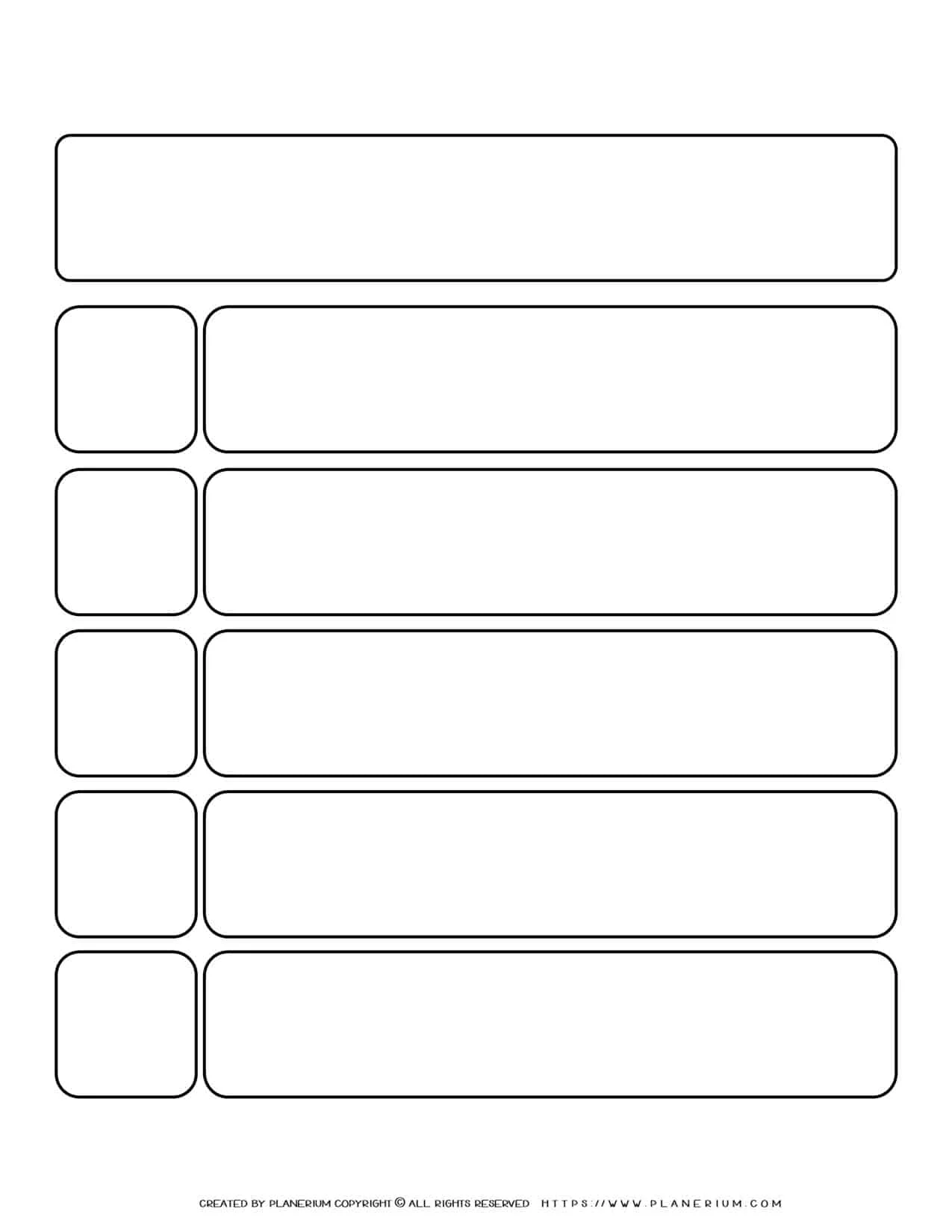
Original printable
Free printable five-section graphic organizer with a headline area for organizing main ideas, key details, steps, categories, and research notes. A flexible visual thinking template for Grades 2-6.
Learning Objective
Students will improve reading comprehension by organizing ideas from a story using a five-section graphic organizer.
Teacher-Selected Inputs
Why this printable fits
The graphic organizer provides a structured way for students to break down and categorize essential elements of a text, fostering better comprehension and critical analysis, which aligns perfectly with sixth-grade expectations.
Key Vocabulary
- graphic organizer
- comprehension
- elements of a story
- summary
- details
Prerequisite Skills
- Basic reading skills
- Ability to summarize main ideas
Materials
- Printed Five Sections Chart
- Sample text for reading (short story or article)
- Markers or pencils
Prep
- Print one Five Sections Chart for each student.
- Select a short text that includes clear characters, settings, and events.
Lesson Steps
- Introduction5 minTeacher actions: Introduce the concept of using graphic organizers to enhance reading comprehension. Explain that this activity will help organize their thoughts and summaries of the text. Show an example of a completed organizer to model what success looks like.Teacher script: Today, we’re going to use a graphic organizer to help us understand a story better. This will help us figure out the main ideas and important details simply and clearly!Example / model: Show a filled-out organizer with a brief story about a student helping a friend, summarizing who, what, when, where, and key feelings.Printable use: Distribute the Five Sections Chart printable to each student for their use during the reading activity.Move on when: Look for students who understand the purpose of the graphic organizer and are ready to start reading.Support if needed: Provide a partially filled example of the organizer for visual support.
- Reading10 minTeacher actions: Read the selected text aloud, pausing at key points to guide students’ thoughts. Ask students to listen for significant information they can record in their graphic organizer. Remind them to think about characters, settings, problems, and feelings.Teacher script: As we read, think about who the story is about, where it takes place, and what happens!Example / model: Point out specific characters or plot points during reading.Printable use: Instruct students to fill in relevant information into their graphic organizers as they listen. They can jot down notes or keywords that relate to the categories.Move on when: Ensure students are engaging with the text and making connections to their graphic organizer.Support if needed: Encourage note-taking using simple words or phrases to help organize thoughts.
- Discussion and Completion10 minTeacher actions: After reading, guide students in discussing their charts. Ask them to share some of their key points and why they chose those details. Encourage students to complete any sections they haven’t filled out based on the discussion.Teacher script: Now that we’ve finished reading, let’s share what we wrote. Who would like to start?Example / model: Student A shares their summary about the main character and Student B can add a detail from the story that fits.Printable use: Allow students to further refine their charts based on peer feedback from the discussion.Move on when: Observe students as they participate in the discussion and adjust their organizers based on new insights.Support if needed: Provide sentence starters to help students articulate their thoughts, such as 'One important detail I noticed was…
- Reflection5 minTeacher actions: Prompt students to reflect on their reading and organizer. Ask how using the organizer helped them understand the text better and what they found challenging.Teacher script: How did using this graphic organizer help you understand the story better? What parts were tricky?Example / model: Collect responses and share some insights as a group.Printable use: Use this reflection time to evaluate students’ understanding and ensure they've utilized the organizer effectively.Move on when: Check for student engagement and insight in their reflections about the text and the organizer.Support if needed: Facilitate one-on-one conversations for students struggling with reflection.
Checks for Understanding
- Students can articulate the key elements of the story they identified.
- Students share relevant details from their graphic organizers during discussion.
- Students complete their graphic organizers fully based on the reading.
Success Criteria
- Students will accurately fill in all five sections of the graphic organizer while demonstrating comprehension of the text.
- Students will participate actively in sharing discussion points with peers.
- Students will articulate connections between the text and their entries in the organizer.
Differentiation
- Provide sentence frames or word banks for students who struggle with writing. Allow advanced students to add additional detail or connections in their own words
- Offer audio recordings of the text for auditory learners or struggling readers.
Accommodations
- Provide a blank organizer with headings only for students needing more structured guidance.
- Allow additional time to complete the graphic organizer as needed.
Common Misconceptions
- Students may confuse the elements in the organizer and mix up facts or characters.
- Some might underestimate the importance of summarizing key details.
Assessment
- Review each student's completed graphic organizer for comprehension accuracy.
- Observe student participation during discussions to gauge overall understanding.
Extensions
- Encourage students to write a short paragraph summarizing the full story using their graphic organizer as a guide.
- Have students create a new graphic organizer for a different text they've read recently.
How to Use the Printable
- Utilized throughout reading to aid comprehension and structure responses visually.
- Will serve as both a note-taking tool and a discussion guide during review.
Teacher Notes
- Be prepared to model parts of the graphic organizer if students struggle with certain sections.
- Monitor discussion for inclusivity, ensuring all voices are heard. Focus on facilitating a supportive environment.