
Planerium AI Lesson Plan
Health & Body: Creating a School Timetable
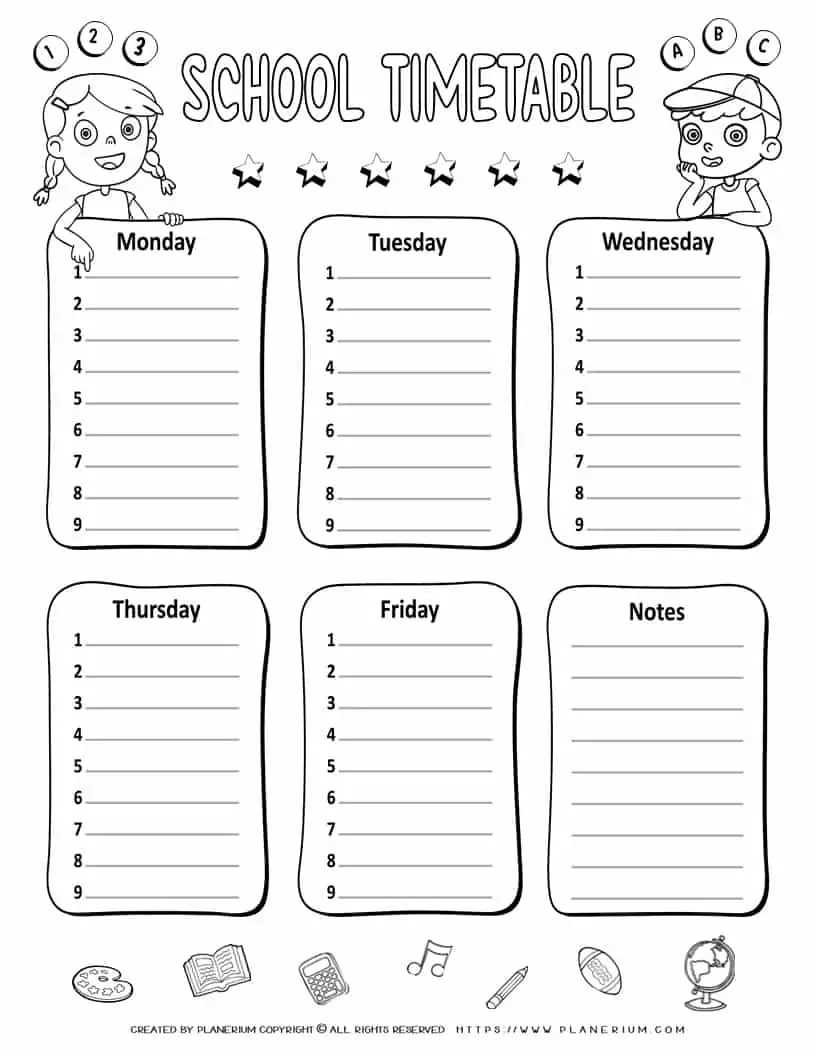
Original printable
Back to School Printables School timetable template printable for primary students. Give your students' a timetable in the first week of school Encourage students to write their schedule for each day of the week in the classroom, and then sent it home to parents. Vis
Learning Objective
Students will create a weekly school timetable to organize their subjects and activities.
Teacher-Selected Inputs
Why this printable fits
This printable provides a structured way for students to organize and visualize their weekly schedule, linking Health concepts of organization with practical skills.
Vocabulary
PRE-TEACH
- timetable: A chart showing the times of classes or activities.
- schedule: A plan for when things will happen.
- organize: To arrange things in a neat and efficient way.
USE DURING LESSON
- Monday
- Tuesday
- Wednesday
- Thursday
- Friday
Materials
- Printed school timetable from Planerium
- Pencils
- Markers
- Sample weekly subject list
Prep
- Print out the school timetable for each student.
- Prepare a sample weekly subject list to share with the class.
Lesson Steps
- Introduction to Timetable8 minTeacher actions: Explain the concepts of a timetable and schedule. Show the sample weekly subject list.Teacher script: Today, we will create our own school timetable! A timetable helps us manage our time and stay organized. Here's a sample list of subjects.Example / model: Display the subjects like Math, Science, English, etc.Printable use: Introduce the printable as the timetable students will fill out.Move on when: Observe if students understand what a timetable is.Support if needed: Provide a sentence frame: 'On [day], I have [subject].
- Filling Out Timetable8 minTeacher actions: Guide students in filling out their timetable using the sample list. Walk around to assist as needed.Teacher script: Now, let's write our subjects into the timetable! Start with Monday and fill in what you have for each period.Example / model: For instance, write 'Math' in the first box for Monday.Printable use: Students will fill out their timetable with subjects and activities.Move on when: Look for students who have correctly filled in at least one subject for Monday.Support if needed: Provide a word bank card naming subjects like Math, Science, Art.
- Sharing and Revising Timetable7 minTeacher actions: Have students turn to a partner and share their timetable. Ask them to revise based on partner feedback.Teacher script: Now, share your timetable with a partner. Do you want to make any changes based on what your partner has?Example / model: A student might change their 'Art' class to 'PE' after discussion.Printable use: Students will have a chance to revise their timetable for accuracy.Move on when: Listen for conversations about how students might adjust classes.Support if needed: Assign partners who can help each other fill in any missing details.
- Closure and Reflection7 minTeacher actions: Conclude by asking students to reflect on their timetable and its importance in managing their time.Teacher script: Why is having a timetable important for our week?Example / model: Students may say it helps them remember what classes to attend and stay organized.Printable use: Encourage students to take their completed timetable home.Move on when: Check if students can articulate at least one benefit of using a timetable.Support if needed: Prompt students with guiding questions: 'How does this help you plan your week?
Formative Check
- Step: Filling Out Timetable
- Ask students to: Fill out at least one subject for Monday.
- Look for: Students can accurately name and write down one subject in their timetable.
Success Criteria
- Students can identify at least 2 key details or vocabulary words connected to Health & Body.
- Students can explain one reason why planning their week is beneficial.
Differentiation
Support: Provide a list of subjects for students who need help.
Scaffold tool: Word Bank Card
Standard: Students will complete the timetable using their own knowledge of subjects and activities.
Extension: Students can add specific activities (like homework or sports) in their timetable for each day.
Early Finishers: Students may create an extra timetable for a different week or reflect on what they learned.
Accommodations
- Provide additional time for filling out the timetable.
- Allow students to verbally explain their timetable instead of writing.
Common Misconceptions
- Students might confuse the terms timetable and schedule, thinking they are not interchangeable.
- Students may believe they cannot change their timetable once it's filled out.
Assessment
- Review completed timetables for accuracy and completeness.
- Listen to partner sharing for understanding of the timetable's importance.
Teacher Notes
Standards
- CCSS.ELA-LITERACY.W.4.4: Produce clear and coherent writing in which the development and organization are appropriate to task and audience.
- CCSS.MATH.CONTENT.4.MD.A.2: Use the four operations to solve word problems involving distances, intervals of time, and money.
IF SHORT ON TIME
- Keep: Filling Out Timetable
- Skip or shorten: Skip the Sharing and Revising Timetable step.
FOLLOW-UP OPTIONS
- Plan a lesson on time management skills using digital tools.
- Create a class calendar for the upcoming month.
- Have students create a visual display of their daily schedule.
HOME CONNECTION
Ask your child to discuss their timetable with you and explain how they organize their week.