
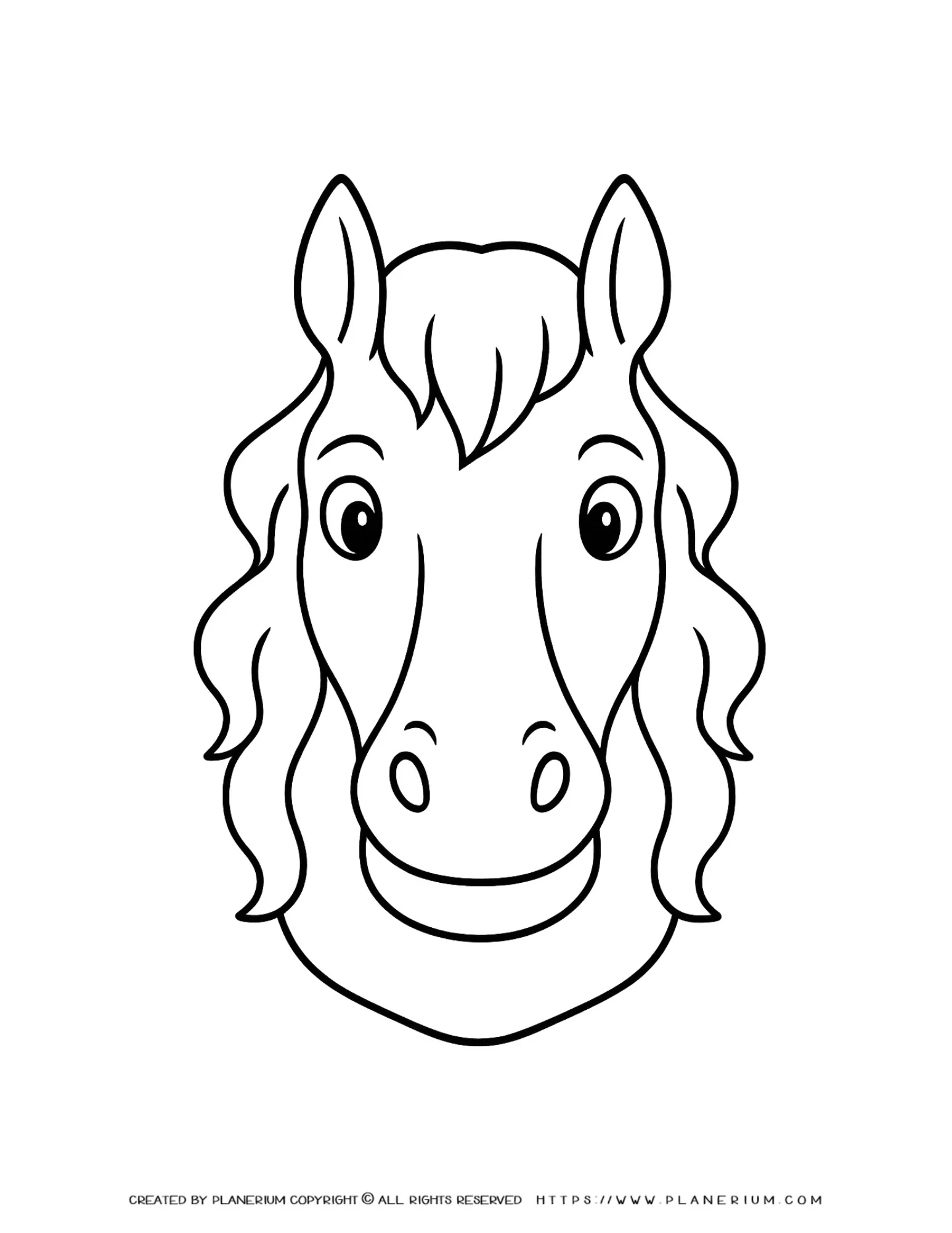
Original printable
Smiling horse face coloring sheet for preschool through early elementary (PreK–2nd grade) featuring a big friendly horse face with bold outlines and simple shapes; includes large areas for crayons/markers/watercolor, tracing and labeling parts of the face, and cutting practice –
Learning Objective
Students will identify and color parts of a horse's face while practicing phonics by labeling key features with beginning sounds.
Teacher-Selected Inputs
Why this printable fits
This printable supports phonics skills by allowing students to practice beginning sounds and engage with vocabulary related to horses in a fun and interactive way, suitable for their grade level.
Key Vocabulary
- horse
- mane
- eye
- ear
- smile
Prerequisite Skills
- Recognizing basic shapes
- Identifying letters and sounds
Materials
- Smiling Horse Face Coloring Sheet
- Crayons or markers
- Word cards with vocabulary
Prep
- Print the Smiling Horse Face Coloring Sheet for each student.
- Prepare word cards with vocabulary words: horse, mane, eye, ear, smile.
Lesson Steps
- Introduction5 minTeacher actions: Introduce the activity by showing the coloring sheet. Ask students if they can name the animal in the picture. Briefly discuss what makes a horse unique and introduce the vocabulary words.Teacher script: Today, we're going to color a big, friendly horse! Can anyone tell me what this animal is?Example / model: A horse has a mane, two ears, and a big smile.Printable use: Display the Smiling Horse Face Coloring Sheet on a projector or turn to a sample page for the class to see.Move on when: Look for students raising their hands or participating in the discussion to confirm understanding of the horse.Support if needed: Provide pictures of horses to students who might struggle to recognize the animal.
- Modeling10 minTeacher actions: Model how to color the horse's face and label parts with beginning sounds. Choose one vocabulary word and demonstrate writing it on the board as you label the corresponding part on the coloring sheet.Teacher script: Let's color the horse. What sound does 'mane' start with? Yes, 'm'!Example / model: Model writing 'mane' next to the mane part of the horse on the sheet.Printable use: Pass out the coloring sheets for students to color as they follow along with the labeling.Move on when: Ensure students are engaged and following your model by watching their coloring and labeling.Support if needed: Walk around to assist those hesitant about how to start coloring or labeling.
- Guided Practice10 minTeacher actions: Circulate around the classroom as students color and label their horses. Encourage them to sound out the words as they write. Offer support and acknowledgment as they identify other parts of the horse's face.Teacher script: Can anyone tell me what this part is called? Let's sound out the word together!Example / model: Check to see if students label 'eye' and 'ear' accurately.Printable use: Students work on their own coloring sheets while stating the sounds and letters associated with the labels.Move on when: Look for students correctly identifying parts and sounding out the words as they label.Support if needed: Provide verbal prompts for students needing assistance with sounds or spellings.
- Closure5 minTeacher actions: Gather the class together to share their colored horses. Ask students to share one part they labeled along with its sound. Collect the coloring sheets to review later.Teacher script: Who would like to show their beautiful horse and tell us one thing about it? What sound does it start with?Example / model: A student might say, 'This is my horse. The eye starts with an 'e.Printable use: Use the sheets for an informal assessment of students' phonics skills and engagement.Move on when: Confirm students are able to verbalize their labeling and the corresponding sounds.Support if needed: Encourage quieter students by pairing them with a buddy for sharing.
Checks for Understanding
- Listening for correct pronunciation of vocabulary words
- Observing students' ability to label parts of the horse correctly
- Evaluating students' engagement during the coloring activity
Success Criteria
- Students color the horse neatly
- Students label at least three parts of the horse correctly
- Students can articulate the beginning sound of each labeled part
Differentiation
- Provide word cards with pictures for English Language Learners
- Allow some students to simply color while others label parts to their level of comfort
Accommodations
- Provide extra time for students needing it
- Pair students with buddies for support during the activity
Common Misconceptions
- Students may confuse the beginning sounds of words like 'mane' and 'eye
- Some may not recognize that the horse features are labeled parts
Assessment
- Review the labeled coloring sheets for accuracy in phonics and understanding of vocabulary
- Informally assess participation and verbalization during sharing time
Extensions
- Create a mini-book where students can write a sentence about their horse using the vocabulary learned
- Introduce a related animal and repeat the activity to reinforce skills
How to Use the Printable
- Used for coloring, labeling, and developing phonics skills in a cohesive activity.
- The layout encourages student interaction with vocabulary and supports fine motor development.
Teacher Notes
- Be patient and supportive with students having difficulties sounding out words.
- Use this activity as reinforcement of previously taught phonics lessons.
- Consider integrating a read-aloud about horses to set the context before starting.