
Orange Tree – Cut and Glue
1522
Views
60
Prints
7
Saves
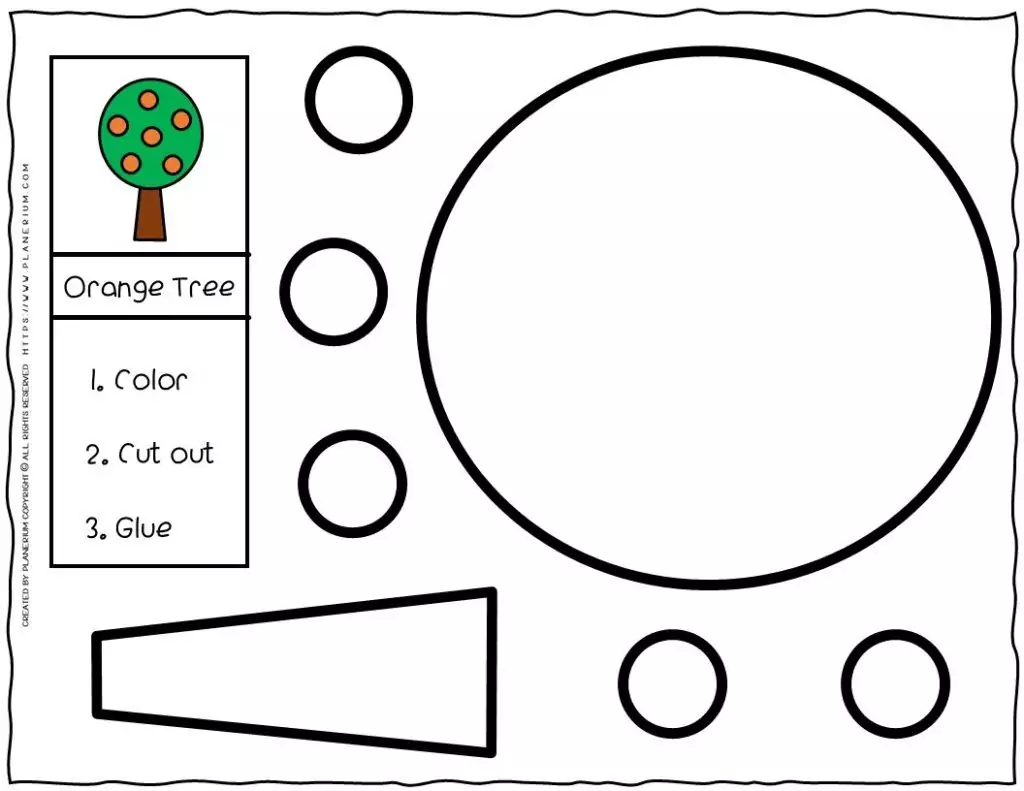
A free printable orange tree cut-and-glue craft for Kindergarten through 2nd grade. Students color, cut, and assemble the trunk, leaves, and oranges to build a complete fruit tree. Builds scissor skills, fine motor control, and sequencing in 15–20 minutes. Perfect for plant units, fruit and nutrition lessons, Earth Day, Arbor Day, farm activities, and Tu B’Shvat celebrations.
Grades
K
First
Second
Tags
Orange Tree Cut-and-Glue Craft for K–2
A free printable tree craft that builds scissor skills and connects to plant, fruit, and Earth Day lessons
The Orange Tree Cut-and-Glue Activity is a free printable craft for Kindergarten through 2nd grade. Students color the trunk, leaves, and oranges, cut out each piece, and glue them together to build a complete fruit tree. The activity strengthens scissor skills, fine motor control, and sequencing, and pairs naturally with plant life science lessons, fruit and nutrition units, Earth Day, Arbor Day, farm studies, and Tu B’Shvat celebrations.
At a Glance
- Grade Levels: Kindergarten – 2nd Grade (ages 5–7)
- Activity Time: 15–20 minutes
- Format: Printable PDF
- Materials Needed: Scissors, glue stick, crayons or markers, cardstock (recommended), blank sheet of paper
- Skills Practiced: Scissor skills, fine motor control, sequencing, plant part recognition, creativity
- Difficulty Level: Easy
- Prep Time: None
How to Use This Printable
- Print the orange tree parts page on cardstock for durability.
- Let students color the trunk, leaves, and oranges with crayons or markers.
- Students cut out each piece along the solid lines.
- Glue the pieces onto a blank sheet of paper — the trunk first, then the leafy canopy on top, and finally the oranges placed among the leaves.
- For an extension, students can label the parts of the tree (roots, trunk, branches, leaves, fruit) or write a few sentences about how fruit grows.
What Students Practice
- Scissor skills and cutting accuracy
- Hand-eye coordination and pincer grip development
- Sequencing (building a tree from base to canopy)
- Plant part recognition (trunk, leaves, fruit)
- Following multi-step directions independently
- Creativity and color exploration
When to Use It
- Plant and tree science units in K–2 Life Science
- Fruit and nutrition lessons on healthy eating and food groups
- Earth Day (April 22) and Arbor Day (last Friday in April)
- Farm-themed classroom units
- Community Helpers studies (farmers, grocers, orchard workers)
- Tu B’Shvat celebrations in Jewish preschools, Hebrew schools, and homeschools
- Five Senses unit (fruit as taste, smell, and touch)
- Florida and California winter citrus season studies
- Spring planting and garden themes
- Homeschool nature study and early botany
Classroom Connections
- NGSS K-LS1-1: Students observe what plants and animals need to survive — fruit trees as living systems that need sunlight, water, and soil.
- NGSS 2-LS2-1: Plants need water and light to grow — orange trees as a real-world, relatable example students already know.
- NGSS 3-LS1-1: Life cycles — from seed to sapling to mature tree to fruit.
- Health & Nutrition: Fruit as part of a balanced plate; where citrus fruit comes from and why it matters.
- Tu B’Shvat Connection: Tu B’Shvat, the Jewish New Year of the Trees (15th of Shevat, in January or February), celebrates trees and fruit. This craft is an ideal hands-on activity for Jewish preschool, Hebrew school, Sunday school, and homeschool Tu B’Shvat lessons.
Teacher Tips
- Print on cardstock so the small orange shapes hold up through cutting and gluing.
- For younger students or those with fine motor challenges, pre-cut the smallest fruit shapes.
- Pair with a nonfiction book about how fruit grows, or a short video of an orange grove in harvest season.
- Extend with a taste test — bring in fresh orange segments and have students describe the flavor, smell, and texture.
- Display finished trees as a “Class Orchard” bulletin board with each student’s tree lined up side by side.
Frequently Asked Questions
Is this orange tree craft printable free?
Yes. This orange tree cut-and-glue activity is completely free to download and use in classrooms, homeschools, therapy sessions, and at home.
What grade levels is this craft for?
It is designed for Kindergarten through 2nd grade (ages 5 to 7). Pre-K students can complete it with teacher-assisted cutting, and older students can extend it with plant-part labels or short writing about the fruit life cycle.
How long does the activity take?
Most students complete the craft in 15 to 20 minutes, depending on how much time they spend coloring and adding details.
What materials do I need?
Scissors, a glue stick, crayons or markers, the printed orange tree page, and a blank sheet of paper or cardstock for the final assembly.
Does this work for a plant or fruit science unit?
Yes. The craft reinforces plant parts (trunk, leaves, fruit) and opens discussions about how fruit grows, where oranges come from, and what plants need to thrive.
Can I use this for Tu B’Shvat?
Yes. Oranges are a classic Tu B’Shvat fruit, and the craft fits beautifully into Jewish preschool, Hebrew school, Sunday school, and homeschool celebrations of the Jewish New Year of the Trees.
Is this a good Earth Day or Arbor Day activity?
Yes. The orange tree craft is a hands-on way to celebrate trees, fruit, and the environment on Earth Day (April 22) and Arbor Day (the last Friday in April).
Looking for more nature and plant activities? Dig into our cut-and-paste craft library, explore our plant and nature coloring pages, or browse early learning worksheets – all free for classroom and homeschool use.