
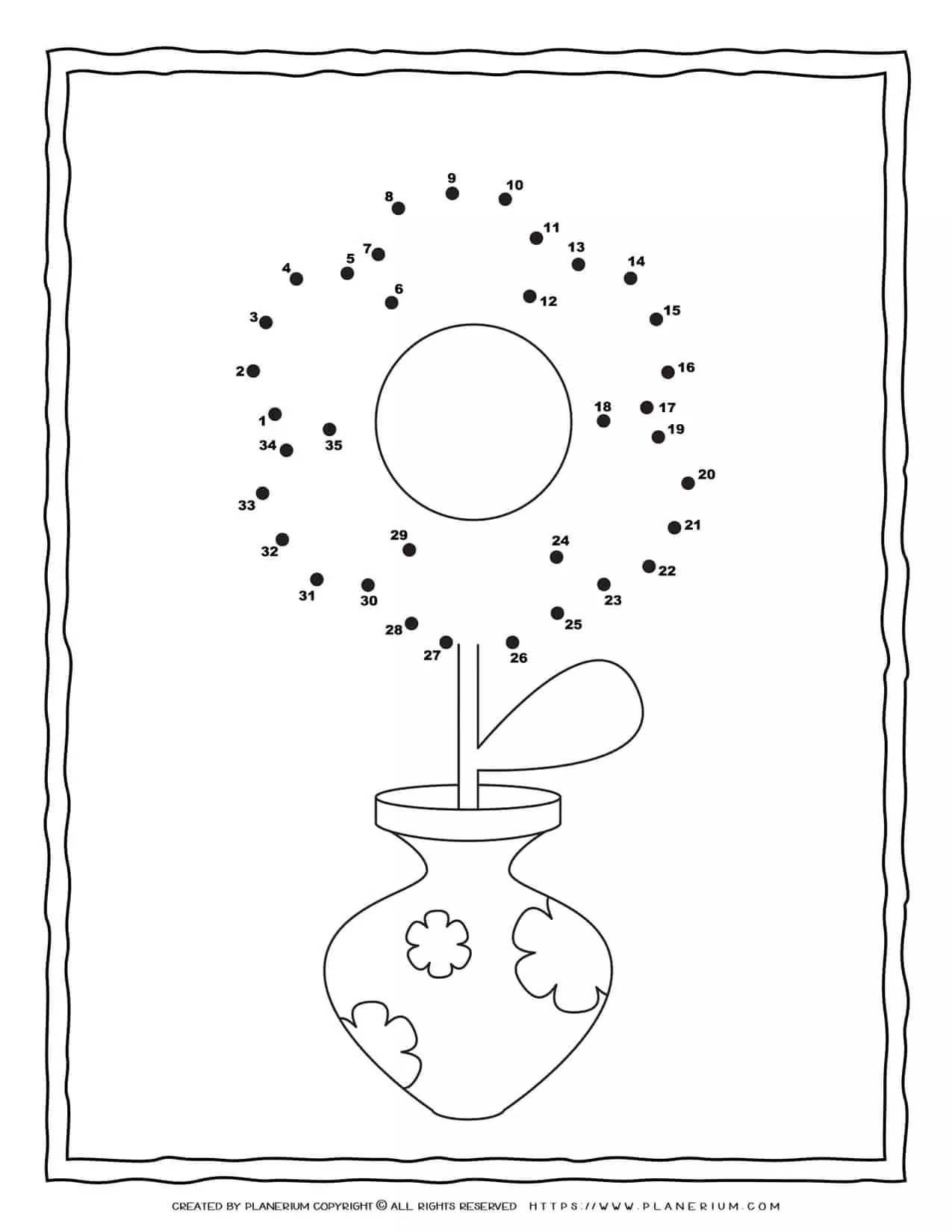
Flower – Connect The Dots
1414
Views
56
Prints
4
Saves
A free printable flower connect-the-dots activity for 1st and 2nd grade. Students count from 1 to 30 in order, connect the dots with a pencil, then color the finished flower in a vase. Builds counting fluency, number recognition, number sequencing, and pencil control in 15–20 minutes. Perfect for math centers, morning work, spring units, and Mother’s Day activities.
Grades
First
Second
Flower Connect the Dots 1–30 for 1st and 2nd Grade
A free printable connect-the-dots flower for 1st and 2nd grade that builds counting fluency, number recognition, and pencil control
The Flower Connect the Dots is a free printable math activity for 1st and 2nd grade. Students count from 1 to 30 in the correct order, connect each numbered dot with a pencil line, and reveal a flower in a vase. Once the picture appears, they color the finished flower however they like. The activity strengthens counting fluency, number recognition, number sequencing, fine motor control, and visual tracking — and pairs naturally with spring units, Mother’s Day card crafts, math morning work, and independent center practice.
At a Glance
- Grade Levels: 1st – 2nd Grade (ages 6–8)
- Activity Time: 15–20 minutes
- Format: Printable PDF (1 page)
- Number Range: 1 to 30
- Materials Needed: Pencil, crayons or markers, printable page
- Skills Practiced: Counting fluency, number recognition (1–30), number sequencing, fine motor control, visual tracking
- Difficulty Level: Easy
- Prep Time: None — print and go
How to Use This Printable
- Print the flower connect-the-dots page on regular paper or cardstock.
- Students start at the dot labeled “1” and draw a line to the dot labeled “2,” then to “3,” and continue counting in order until they reach the final number.
- As the lines connect, the outline of a flower in a vase is revealed.
- Students color the finished flower however they like — solid colors, patterns, or rainbow-style.
- For an extension, students can label the flower’s parts (petals, stem, leaves, vase), write the numbers in order on a separate sheet, or count backwards from the highest number to 1.
What Students Practice
- Number recognition from 1 to 30
- Counting in sequence with one-to-one correspondence
- Number ordering and “what comes next?” thinking
- Fine motor control and pencil grip
- Visual tracking and scanning the page in order
- Hand-eye coordination
- Following multi-step directions independently
- Color choice and creative expression in the coloring stage
When to Use It
- Math centers and morning work in 1st and 2nd grade classrooms
- Independent practice for early finishers
- Counting fluency practice for 1st and 2nd grade
- Number sequencing review and warm-ups
- Spring-themed math activities and bulletin boards
- Mother’s Day card crafts (the colored flower becomes a card front)
- Easter activity stations
- Earth Day, Arbor Day, and garden-themed math
- Sub-tub plans and substitute teacher folders
- Homeschool math practice
- Occupational therapy sessions for pencil control
- After-school programs and quiet-time activities
Classroom Connections
- CCSS Math 1.NBT.A.1: Count to 120, starting at any number — students practice fluent counting from 1 to 30 as a building block.
- CCSS Math 1.OA.C.5: Relate counting to addition — connecting dots in order reinforces “next number” thinking that supports addition fluency.
- CCSS Math 2.NBT.A.2: Count within 1000; skip-count by 5s, 10s, and 100s — extension activity for 2nd grade includes counting backwards from 30 to 1 or skip-counting variations.
- Fine Motor & Visual-Motor Skills: Connect-the-dots activities are widely used in occupational therapy to develop pencil control, visual scanning, and crossing the midline.
Teacher Tips
- Print on regular paper for everyday practice, or cardstock if you want students to color heavily and display the finished work.
- For 1st graders early in the year, model the first 5–10 dots together before independent work — especially if students are still building number-recognition fluency.
- Pair with a number line on the wall so students can self-check if they get stuck.
- For 2nd grade, extend the challenge by asking students to time themselves — how fast can they connect all 30 dots accurately?
- Turn the finished flower into a Mother’s Day card by gluing it onto folded cardstock and adding a written message inside.
- Display completed flowers on a “Math Garden” bulletin board where each student’s flower is part of a class-wide spring meadow.
- Combine with a counting-backward extension where students cross out numbers from 30 to 1 after connecting forward.
Frequently Asked Questions
Is this connect-the-dots flower printable free?
Yes. This flower connect-the-dots activity is completely free to download and use in classrooms, homeschools, therapy sessions, and at home.
What grade levels is this activity for?
It is designed for 1st and 2nd grade (ages 6 to 8). 1st graders use it as counting fluency practice that builds toward CCSS 1.NBT.A.1 (counting to 120). 2nd graders use it as a quick warm-up, speed challenge, or extension activity (counting backwards from 30 or skip-counting).
What number range does the activity use?
The activity covers numbers 1 through 30. This range is ideal for 1st grade fluency practice and 2nd grade warm-ups.
Is this activity too hard for Kindergarten?
Most Kindergarten students are still building counting fluency to 20 throughout the year, so 30 dots may be challenging. End-of-year Kindergarten students who are confident with numbers to 30 can attempt it, but for most Kindergarten classrooms, a smaller-range connect-the-dots is a better fit.
How long does the activity take?
Most students complete the activity in 15 to 20 minutes, including the coloring step. Faster students may finish in 10 minutes; students still learning their numbers may take longer.
What materials do I need?
A pencil, crayons or markers, and the printed connect-the-dots page. That’s it — no prep required.
Is this a good math center activity?
Yes. Connect-the-dots pages are classic math center material because they are self-checking (the picture appears correctly only when the numbers are connected in order), require minimal teacher support, and keep students engaged for 15–20 minutes of independent work.
Can I use this for Mother’s Day?
Yes. After students complete the connect-the-dots and color the flower, the finished page makes an instant Mother’s Day card front. Glue it onto folded cardstock and let students write a message inside.
Does this work for occupational therapy or fine motor practice?
Yes. Connect-the-dots activities are widely used by occupational therapists to build pencil control, visual scanning, hand-eye coordination, and crossing the midline – all critical pre-writing skills.
Looking for more number and math printables? Connect with our full math games library, browse number worksheets, or explore seasonal coloring pages — all free for classroom and homeschool use.