V Letter – English Alphabet
897
Views
9
Prints
6
Saves
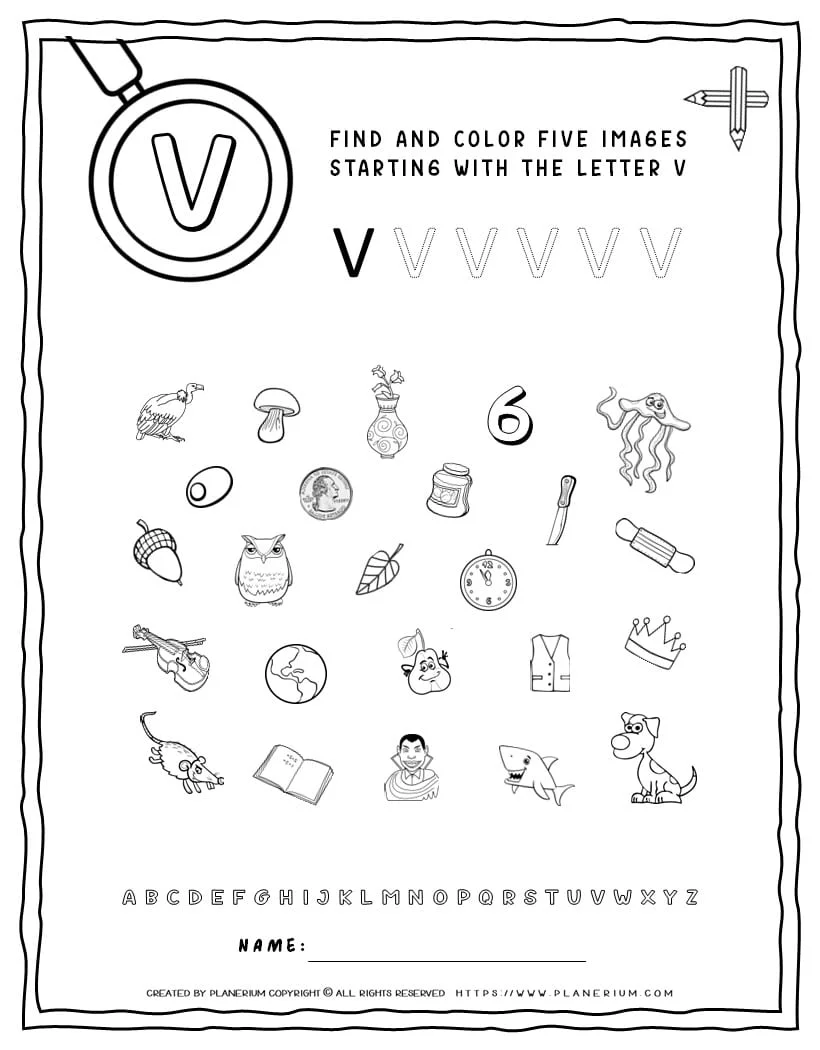
Letter V worksheet for classroom or homeschool students features tracing of the capital V, a locate-and-color task with five V words (violin, vampire, vest, vulture, vase), and word–picture association to build stroke formation, letter recognition, phonics support, and fine-motor control.
Grades
K
First
Second
About V Letter – English Alphabet Worksheet
What Learning Goal Can This Worksheet Support?
This printable helps students practice the capital V by tracing the letter and strengthens letter recognition through a locate-and-color task featuring five V words. It supports teachers who want focused stroke-formation practice while introducing vocabulary (violin, vampire, vest, vulture, vase) in a simple, teacher-kind layout.
Skills Practiced:
- Tracing the capital V (stroke formation)
- Letter recognition for the V letter
- Word–picture association with five V images (violin, vampire, vest, vulture, vase)
- Vocabulary introduction for V-starting words
- Fine-motor control through tracing and coloring
- Phonics support for initial V sound (as a supplement to phonics lessons)
Teacher-Friendly Ways to Use This Worksheet:
- Use as a warm-up: have students trace the capital V and then locate and color the five images to begin a phonics block.
- Rotate in a center: place the worksheet at an art-integrated table so learners can focus on stroke formation and word–picture association (violin, vampire, vest, vulture, vase) at their own pace.
- Assign for homework or early finishers: ask students to complete the tracing and coloring to reinforce classroom instruction and extend vocabulary practice beyond the lesson.
- This worksheet fits easily into K–2 routines and keeps the focus on handwriting, visual recognition, and starter-word vocabulary within a single teacher-ready printable.
FAQ
This worksheet targets capital V stroke formation through tracing and strengthens letter recognition with a locate-and-color task featuring five V words (violin, vampire, vest, vulture, vase). It also introduces starter vocabulary and provides phonics support for the initial V sound while building fine-motor control.
Use it as a warm-up by having students trace the capital V then locate and color the five V images to begin a phonics block, rotate it in a center for independent practice, or assign it to early finishers or for homework to reinforce instruction. The simple, teacher-ready layout fits easily into K–2 routines and art-integrated tables.
For support, model the two-stroke formation, let learners trace larger or darker guide lines, and provide one-on-one or partnered prompting during the locate-and-color task. For a challenge, ask students to name or find additional V words beyond the five pictured and practice producing the initial V sound in isolation and in words.
Have each student choose one of the five images to describe aloud or illustrate further, then identify other classroom items that start with V to extend vocabulary and phonics practice. This keeps the focus on initial-sound awareness while reinforcing the traced capital V and word–picture links.
Observe students’ traced capital V for correct stroke formation and consistent shape, and check that they can accurately locate and color the five V images and connect each picture to its word. Listen for correct initial V sound production during naming to assess phonics transfer and note improvements in fine-motor control over repeated attempts.
More in this series