
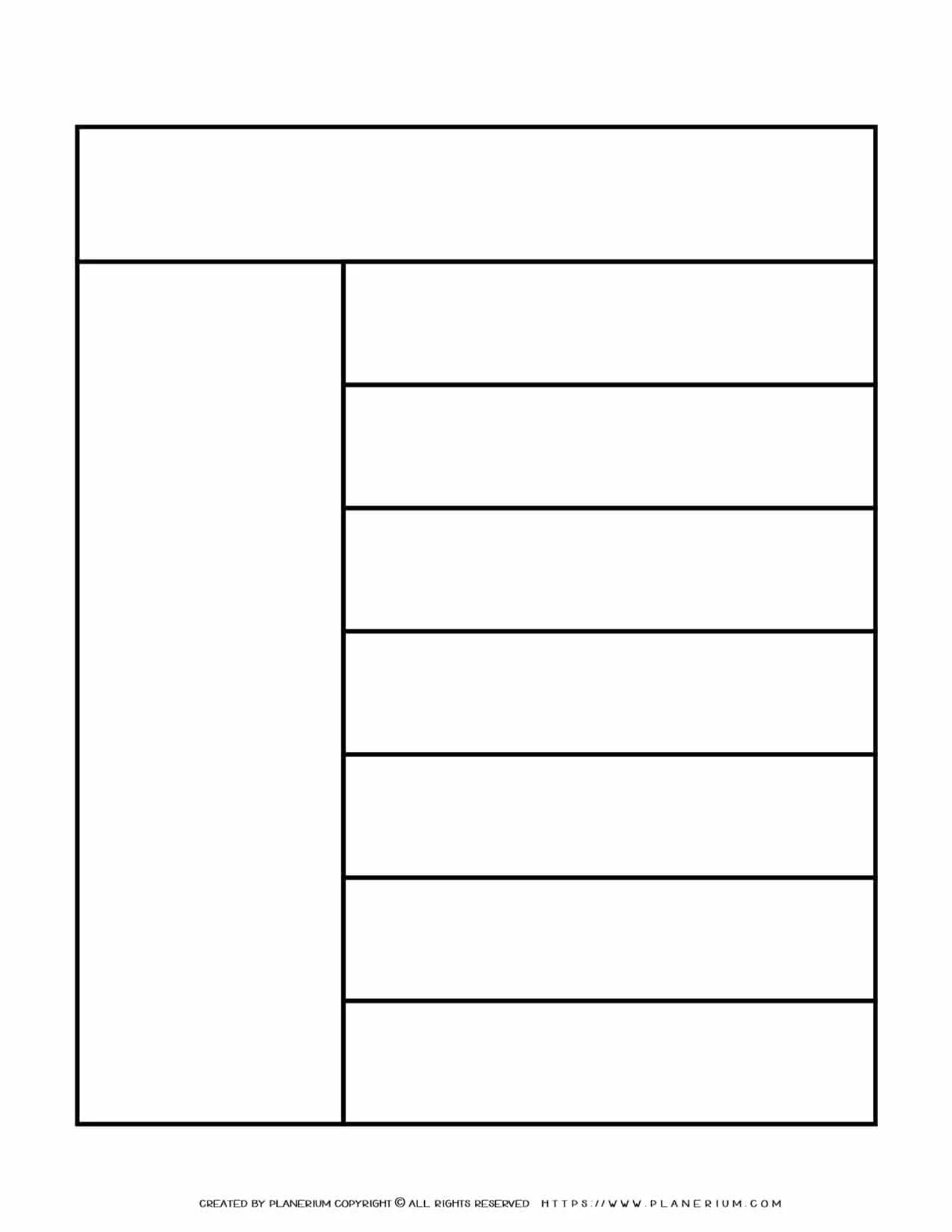
Chart with One Column and Seven Rows
3083
Views
159
Prints
19
Saves
Free printable one-column, seven-row chart for organizing steps, facts, vocabulary, observations, and classroom activities. A simple blank graphic organizer for Grades 2-6.
Free Printable 7-Row Chart – One-Column Graphic Organizer
This free printable one-column, seven-row chart gives students a simple visual structure for organizing information into seven clear sections.
The blank layout can be adapted to many classroom activities, including sequencing, vocabulary, research, observations, planning, and note-taking. Each row provides a separate space for one idea, step, fact, word, or response.
Because the organizer does not include fixed labels, teachers can easily adapt it to different subjects and learning goals.
Classroom Ideas
Use this printable seven-row chart to help students:
- Organize seven steps in a process
- Record seven facts about a topic
- List vocabulary words and short definitions
- Sequence events from a story or historical topic
- Record observations during a science activity
- Organize research notes
- Plan parts of a project or presentation
- Collect examples related to one topic
- Record key ideas from a lesson, book, or video
Suggested Grade Levels
This graphic organizer is especially useful for Grades 2-6.
For younger students, teachers can add numbers, pictures, or short prompts before printing. Students can also use drawings, symbols, or single words instead of full written responses.
Older students can use the chart independently for sequencing, summarizing, research, and structured note-taking.
Why Use a Seven-Row Graphic Organizer?
A simple vertical chart helps students focus on one piece of information at a time while keeping all seven items visible on one page.
The structure works especially well when information has a clear order or belongs to one main topic.
Unlike a multi-column chart, this organizer does not ask students to compare categories. Instead, it supports linear thinking, sequencing, listing, and breaking a larger topic into manageable parts.
Ideas Across Subjects
Language Arts:
Sequence story events, collect key details, organize vocabulary, or list ideas before writing.
Science:
Record stages in a process, observations, characteristics, or facts about a scientific topic.
Social Studies:
Organize events in chronological order, record facts about a country or historical figure, or summarize key points from a lesson.
Vocabulary and Language Learning:
Use each row for a word, definition, translation, example sentence, or related term.
Project Planning:
Use the seven rows to organize tasks, steps, questions, or research points before beginning a project.
Explore More Graphic Organizers
Looking for a different structure?
Explore the full Graphic Organizer Templates collection for more free charts, sequence organizers, story maps, and visual thinking templates.
You may also find these layouts useful:
- 3-Column 6-Row Chart – useful when students need to compare or organize several pieces of information across three categories.
- Blank Three-Column Chart – an open layout for comparing or sorting information into three sections.
- 3-Column 2-Row Chart – useful for shorter comparison activities.
- Five-Section Graphic Organizer with Headline – useful for organizing one central topic into five supporting ideas.
- Sequence Chart – Eight Circles on a Circle – a more visual option for organizing steps or ideas in a cyclical sequence.
FAQ
What is a seven-row graphic organizer used for?
It can be used for sequencing, listing facts, organizing vocabulary, recording observations, planning projects, or breaking a topic into seven parts.
When should I use a one-column chart instead of a multi-column chart?
A one-column chart works best when students need to organize information in a single sequence or list. Multi-column charts are better for comparing or sorting information across several categories.
What grade levels is this printable suitable for?
It is especially useful for Grades 2-6. Younger students can use teacher-added prompts, pictures, or numbers, while older students can work more independently.
Can this chart be used for sequencing?
Yes. Number the rows from 1 to 7 and use them to organize story events, process steps, historical events, or instructions in order.
Can students draw instead of write?
Yes. Each row can contain words, short sentences, symbols, diagrams, or drawings depending on the activity.