
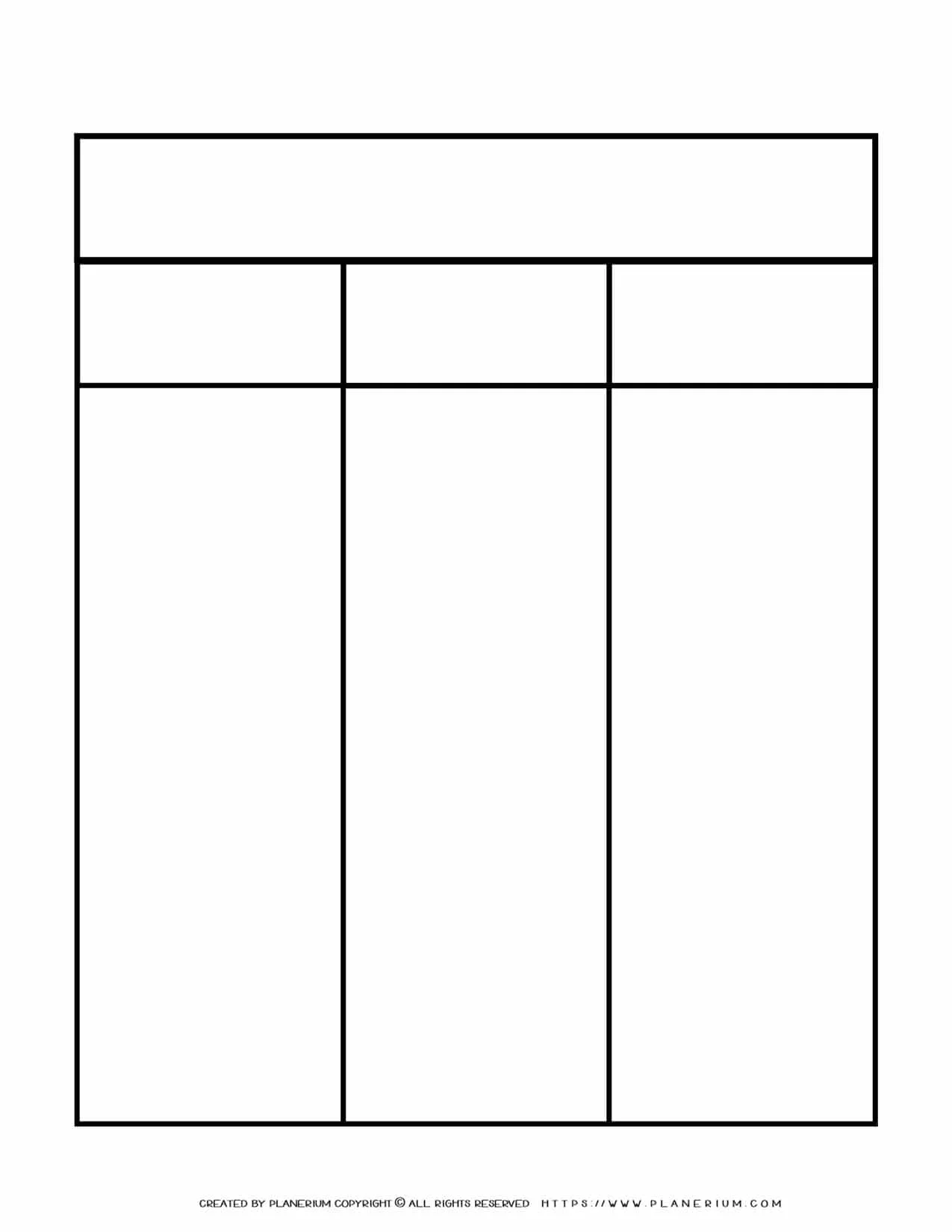
Chart with Three Columns and Two Rows
2982
Views
130
Prints
22
Saves
Free printable 3-column, 2-row chart for comparing ideas, sorting information, organizing vocabulary, and classroom activities. A simple blank graphic organizer for Grades 2-6.
Free Printable 3-Column 2-Row Chart – Blank Graphic Organizer
This free printable 3-column, 2-row chart is a simple and flexible graphic organizer for comparing, sorting, and organizing information in a clear visual structure.
The layout includes three columns and two large rows, giving students enough space to record short notes, keywords, examples, or drawings without making the activity feel crowded.
It works especially well for short comparison tasks, sorting activities, vocabulary work, and quick classroom exercises.
Classroom Ideas
Use this printable chart to help students:
- Compare three characters, people, places, objects, or concepts
- Sort information into three categories
- Organize vocabulary words and examples
- Record similarities and differences
- Collect key facts from a short text or lesson
- Compare scientific properties or observations
- Organize ideas before a short writing task
- Sort examples and non-examples
- Record information from a class discussion or video
Suggested Grade Levels
This graphic organizer is especially suitable for Grades 2-6.
For younger students, teachers can add simple headings, pictures, or short prompts before printing. Older students can use the blank chart more independently for comparison, note-taking, and review activities.
Why Use a 3-Column 2-Row Graphic Organizer?
A smaller chart can be useful when students need structure without too many boxes.
The three columns allow students to organize information across three topics or categories, while the two rows keep the activity focused and manageable.
This makes the template useful for quick comparison tasks, warm-ups, review activities, or assignments where students only need to record a small amount of information.
Ideas Across Subjects
Language Arts:
Compare three characters, sort vocabulary, record two key details about each topic, or organize examples from a text.
Science:
Compare three animals, plants, materials, habitats, or scientific concepts using two characteristics or observations.
Social Studies:
Compare countries, communities, historical figures, geographic regions, or events.
Vocabulary and Language Learning:
Use the columns for three words or categories and the rows for definitions, examples, translations, or related terms.
Explore More Graphic Organizers
Looking for more space or a different structure?
Explore the full Graphic Organizer Templates collection for more free charts and visual thinking templates.
You may also find these layouts useful:
- 3-Column 6-Row Chart – a more structured option for recording several pieces of information across three categories.
- Blank Three-Column Chart – an open layout with three large sections and no fixed rows.
- Five-Section Graphic Organizer with Circles – useful for organizing five main ideas, steps, or categories.
- Five-Section Graphic Organizer with Headline – useful when students need to organize several related ideas under one main topic.
FAQ
What is a 3-column 2-row chart used for?
It can be used for short comparison activities, sorting information, vocabulary practice, organizing key facts, or recording two details about three topics or categories.
What grade levels is this printable suitable for?
It is especially useful for Grades 2-6. Teachers can simplify it for younger students by adding headings, pictures, or short prompts.
How is this different from the 3-column 6-row chart?
The 2-row version is better for shorter activities and smaller amounts of information. The 6-row version provides more structure and space for several corresponding entries.
Can this graphic organizer be used in different subjects?
Yes. The simple layout can be adapted for language arts, science, social studies, vocabulary, research, and cross-curricular activities.
Can students draw in the chart?
Yes. The large cells can be used for keywords, short sentences, symbols, diagrams, or drawings.