
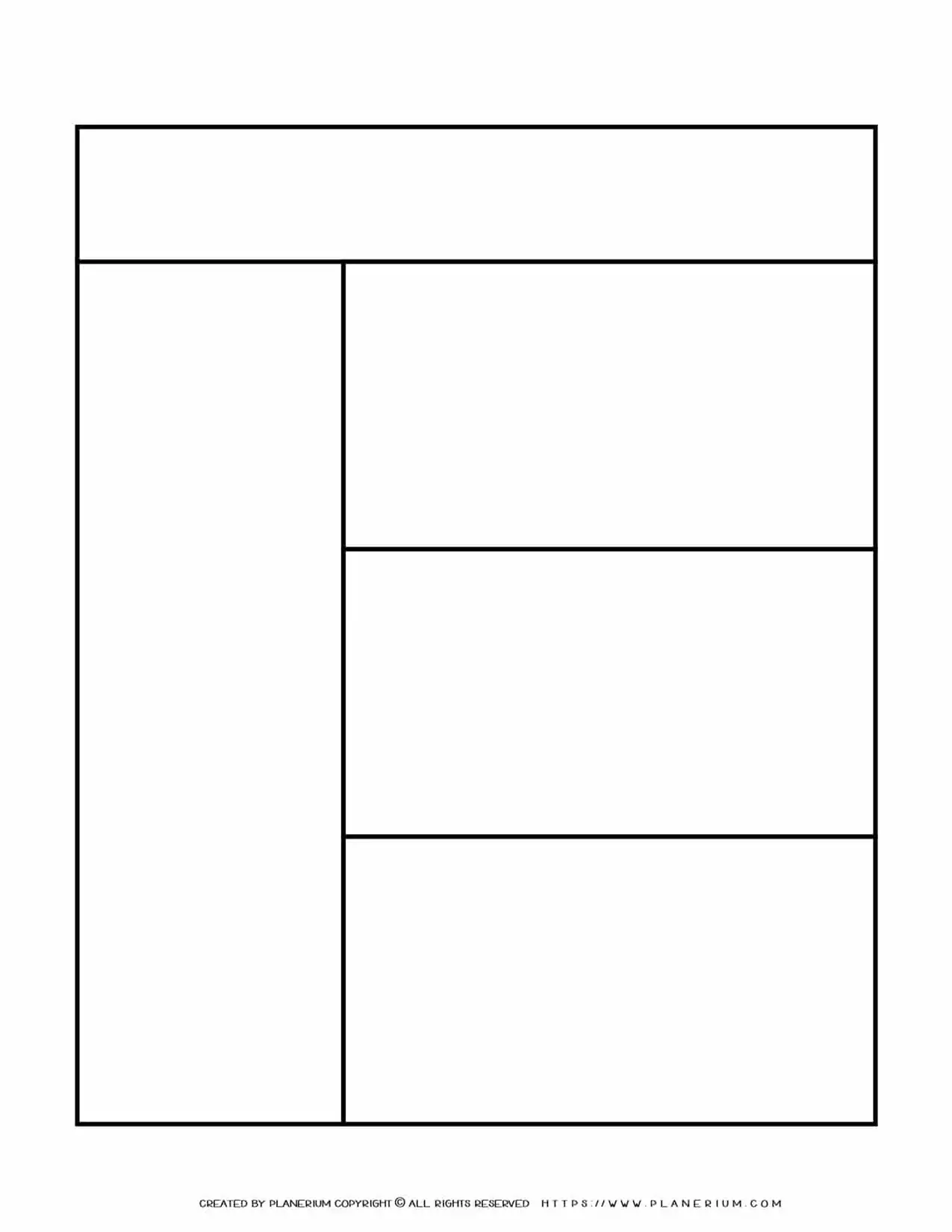
Chart with One Column and Three Rows
1539
Views
25
Prints
6
Saves
Free printable graphic organizer with a top heading, one large side section, and three smaller sections for organizing a main topic with three related facts, ideas, categories, or supporting details. Suitable for Grades 2-6.
Graphic Organizer with Main Section and Three Supporting Sections
This free printable graphic organizer with one large section and three supporting sections helps students connect one central topic with three related ideas, facts, categories, examples, or details.
The template includes a heading area at the top, one large vertical section on the left, and three larger sections stacked on the right.
This simple structure works well when students need to focus on one main concept and three important pieces of supporting information.
Classroom Ideas
Use this printable organizer to help students:
- Organize one main idea and three supporting details
- Record three facts about a topic
- Compare three characteristics of one subject
- Organize three examples related to a concept
- Break a topic into three categories
- Plan three supporting points before writing
- Record three observations in science
- Summarize a lesson using three key ideas
- Organize research notes
- Connect one question with three possible answers or findings
Suggested Grade Levels
This graphic organizer is especially useful for Grades 2-6.
For younger students, teachers can place a picture, title, or keyword in the large section and use the three smaller areas for drawings, labels, or short responses.
Older students can use the organizer independently for summarizing, research, note-taking, and writing preparation.
How Can Students Use the Different Sections?
The large left section can hold:
- A main topic
- A central idea
- A character
- A question
- A concept
- A title or prompt
The three sections on the right can be used for:
- Supporting details
- Examples
- Characteristics
- Facts
- Categories
- Evidence
- Key ideas
- Observations
This layout helps students see how three important pieces of information connect to one central focus.
Ideas Across Subjects
Language Arts:
Use the large section for a character, story, or main idea and the three sections for traits, evidence, events, or supporting details.
Science:
Place an animal, plant, habitat, material, or scientific concept in the large section and record three facts, characteristics, or observations.
Social Studies:
Use the main section for a country, historical figure, event, or community and organize three important facts or features.
Vocabulary and Language Learning:
Place a word or topic in the large section and use the three sections for a definition, example, synonym, translation, or related information.
Writing:
Use the large section for the writing topic or claim and the three sections for supporting points, evidence, or examples.
Explore More Graphic Organizers
Explore the full Graphic Organizer Templates collection for more free charts, comparison templates, sequence organizers, and visual thinking tools.
You may also find these layouts useful:
- Graphic Organizer with Main Section and Five Rows – useful when students need more space for five related details.
- Graphic Organizer with 6 Boxes – useful for organizing one heading with six related pieces of information.
- Five-Section Graphic Organizer with Headline – useful for organizing one topic into five separate ideas.
- Blank Three-Column Chart – useful when students need three independent categories rather than one main topic with supporting information.
FAQ
What is this graphic organizer used for?
It helps students connect one main topic or idea with three related facts, details, examples, categories, or supporting points.
What should students write in the large section?
The large section can contain the main topic, concept, question, character, title, or central idea.
What can students put in the three sections?
They can use the three sections for supporting details, facts, examples, characteristics, evidence, or key ideas.
What grade levels is this printable suitable for?
It is especially useful for Grades 2-6. Younger students can use drawings and short labels, while older students can add more detailed notes.
Can this organizer be used for writing?
Yes. Students can place the topic or claim in the large section and use the three smaller areas for supporting points or evidence.
Can students draw instead of write?
Yes. The sections can contain drawings, symbols, keywords, short sentences, or a combination of text and visuals.