
Chart with Six Notes
4832
Views
559
Prints
35
Saves
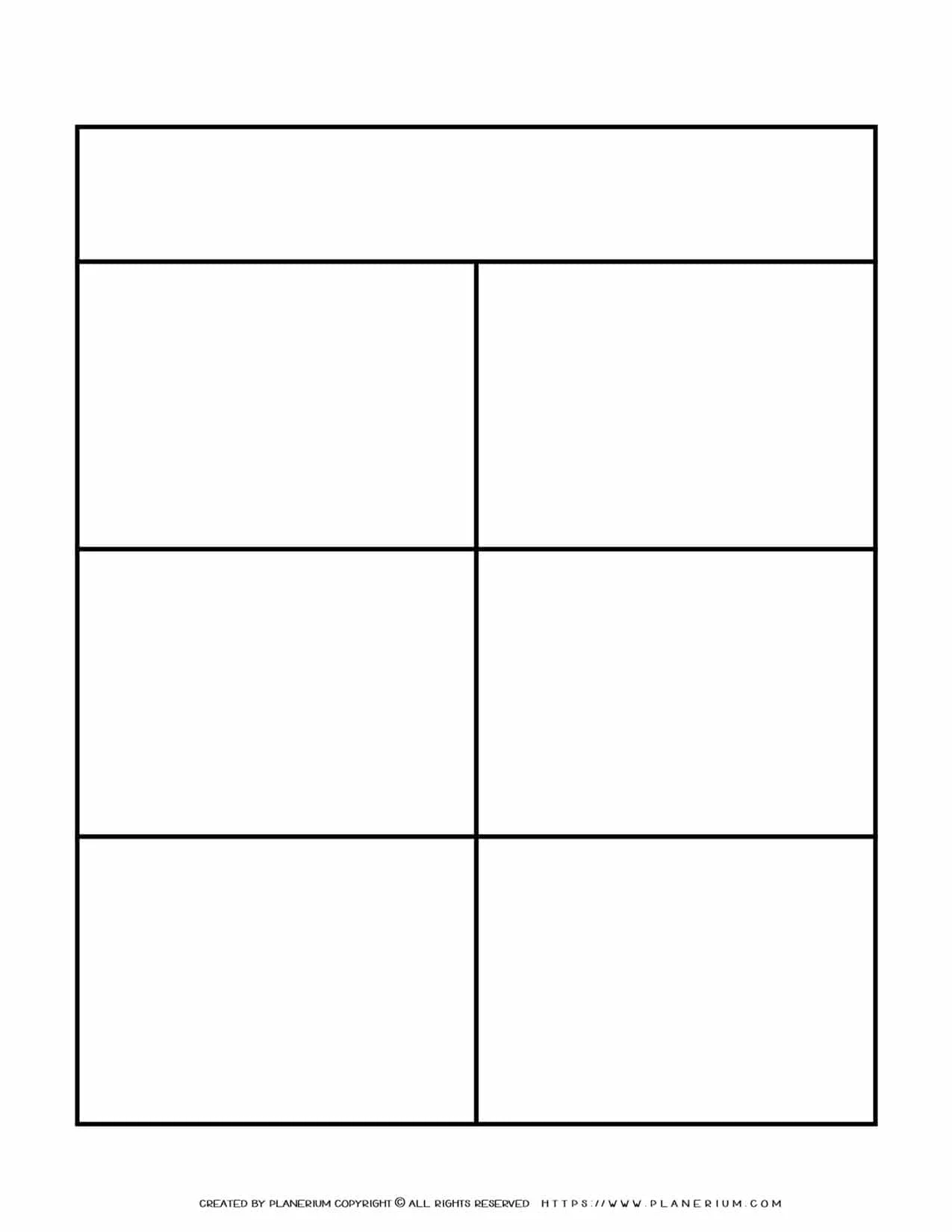
Free printable graphic organizer with a top heading box and 6 content boxes for organizing facts, ideas, categories, vocabulary, research notes, or supporting details. A flexible classroom template for Grades 2-6.
Graphic Organizer with Header and 6 Boxes – Free Printable
This free printable graphic organizer with a heading box and 6 content boxes helps students organize information in a clear and structured way.
The template includes one large box at the top for a title, topic, question, or main idea, followed by six boxes arranged in 2 columns and 3 rows for related facts, details, examples, vocabulary, or notes.
This layout makes it easy for teachers to introduce a central topic and guide students in collecting and organizing key information beneath it.
Classroom Ideas
Use this printable organizer to help students:
- Record six facts about a topic
- Organize six supporting details from a text
- Collect research notes under one main heading
- Sort vocabulary words, meanings, or examples
- Record six observations in science
- Brainstorm ideas before writing
- Organize information from a lesson, book, or video
- Collect six key points for a project or presentation
- Summarize a topic using a title and six related details
Suggested Grade Levels
This graphic organizer is especially useful for Grades 2-6.
For younger students, teachers can write the topic in the top box and allow students to respond with drawings, short labels, or simple words in the six boxes.
Older students can use the organizer more independently for note-taking, research, summarizing, and writing preparation.
Why Use a Header and Six Boxes?
The top heading box gives students a clear place to identify the main topic or idea.
The six boxes underneath help break that topic into smaller, manageable parts.
This can support:
- Organizing facts
- Identifying supporting details
- Collecting examples
- Structured note-taking
- Research
- Brainstorming
- Summarizing information
Because the layout is blank, the same printable can be reused across many subjects and classroom activities.
Ideas Across Subjects
Language Arts:
Use the top box for the story title, reading topic, or writing prompt and the six boxes for supporting details, evidence, vocabulary, or ideas.
Science:
Place the scientific topic in the top box and use the six sections for facts, observations, stages, properties, or examples.
Social Studies:
Use the heading for a country, historical figure, event, or community and fill the six boxes with related facts or features.
Vocabulary and Language Learning:
Write the topic or word family in the top box and use the six sections for words, meanings, examples, translations, or related ideas.
Research and Project Work:
Use the heading for the research topic and the six boxes for findings, questions, subtopics, or presentation points.
Explore More Graphic Organizers
Explore the full Graphic Organizer Templates collection for more free note-taking templates, comparison charts, sequence organizers, and visual thinking tools.
You may also find these templates useful:
- Five-Section Graphic Organizer with Headline – useful for organizing one topic into five supporting sections.
- Five-Section Graphic Organizer with Circles – useful for connecting keywords with larger note sections.
- Chart with One Column and Seven Rows – useful for organizing information in a simple vertical list.
- Chart with Three Columns and Six Rows – useful when students need to organize information in a structured comparison chart.
FAQ
What is this graphic organizer used for?
It helps students organize one main topic and six related facts, ideas, examples, notes, or supporting details.
What should students write in the top box?
The top box can contain a title, topic, question, main idea, or writing prompt.
What can students put in the six boxes below?
They can use the six boxes for facts, details, examples, observations, vocabulary, questions, or supporting information.
What grade levels is this printable suitable for?
It is especially useful for Grades 2-6. Younger students can use drawings and short labels, while older students can add more detailed written notes.
Can this organizer be used for research and note-taking?
Yes. It works well for collecting information under one topic and organizing it into six related parts.
Can students draw instead of write?
Yes. The boxes can be filled with drawings, symbols, keywords, short sentences, or a combination of text and visuals.