
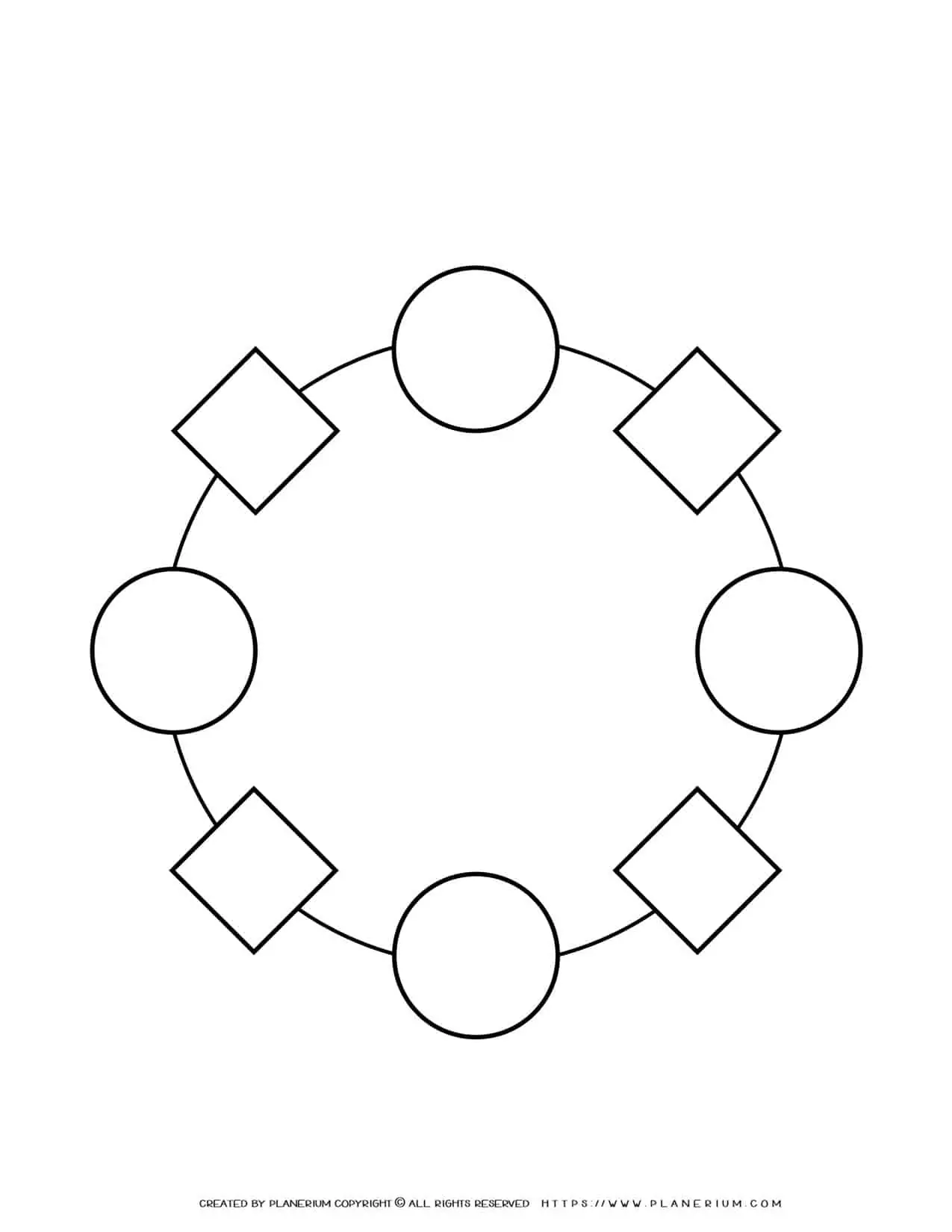
Sequence Chart Template – Four Squares and Four Circles on a Circle
1347
Views
5
Prints
5
Saves
Free printable 4-step sequence chart for story events, processes, routines, projects, and classroom sequencing activities in Grades 2-6.
Four Squares and Four Circles Graphic Organizer – Free Printable
This free printable graphic organizer with four squares and four circles helps students organize four main ideas, steps, stages, or events together with related keywords, labels, or supporting details.
The circular layout visually connects all eight elements, while the combination of larger squares and smaller circles creates a clear distinction between main information and supporting information.
Students can use the squares for larger ideas or explanations and the circles for short labels, numbers, keywords, symbols, or prompts.
Classroom Ideas
Use this printable organizer to help students:
- Organize four main steps with one key detail for each
- Sequence four story events with short labels or keywords
- Show four stages in a process with supporting information
- Organize four main ideas around one topic
- Connect categories with examples
- Plan four parts of a project
- Record four facts with related keywords
- Organize science observations or stages
- Create a visual summary of a lesson or text
Suggested Grade Levels
This graphic organizer is especially useful for Grades 2-6.
For younger students, teachers can place numbers, symbols, or pictures in the circles and let students use the larger squares for drawings or short responses.
Older students can use the layout more independently for summarizing, sequencing, research, writing preparation, and project planning.
Why Use Squares and Circles Together?
Using two different shapes helps students distinguish between different levels or types of information.
The larger squares can hold main ideas, events, steps, or explanations, while the smaller circles can be used for:
- Numbers
- Keywords
- Categories
- Short labels
- Symbols
- Important reminders
This makes the organizer useful when students need more structure than a simple four-part chart, but do not need a large or complex worksheet.
Ideas Across Subjects
Language Arts:
Use the squares for four important story events and the circles for sequence numbers, character names, or short keywords.
Science:
Organize four stages of a process in the squares and place key terms, labels, or observations in the circles.
Social Studies:
Use the squares for four events, people, places, or ideas and the circles for dates, categories, or key terms.
Vocabulary and Language Learning:
Place words or categories in the circles and use the corresponding squares for meanings, examples, sentences, or illustrations.
Project-Based Learning:
Use the four squares for project stages and the circles for a short goal, deadline, task, or keyword connected to each stage.
Explore More Graphic Organizers
Explore the full Graphic Organizer Templates collection for more free sequence charts, comparison templates, and visual thinking tools.
You may also find these layouts useful:
- Four Squares on a Circle Sequence Chart – a simpler four-part circular layout without additional supporting circles.
- Four Squares on a Small Circle – useful for organizing four supporting ideas around a small central topic.
- Four Squares on a Square – useful for a straightforward four-step sequence.
- Spiral Sequence Chart with 10 Circles – useful for longer sequences and processes.
FAQ
What is this graphic organizer used for?
It helps students connect four main ideas, steps, stages, or events with four related keywords, labels, or supporting details.
What should students write in the squares and circles?
The squares are best for main ideas or larger pieces of information. The circles can hold numbers, keywords, categories, symbols, or short labels.
Can this organizer be used for sequencing?
Yes. Students can number the four stages and use the circles to add labels or key details connected to each stage.
What grade levels is this printable suitable for?
It is especially useful for Grades 2-6. Teachers can simplify the activity with pictures or prompts for younger students.
Can students draw instead of write?
Yes. Both the squares and circles can be used for drawings, symbols, keywords, or written responses.