
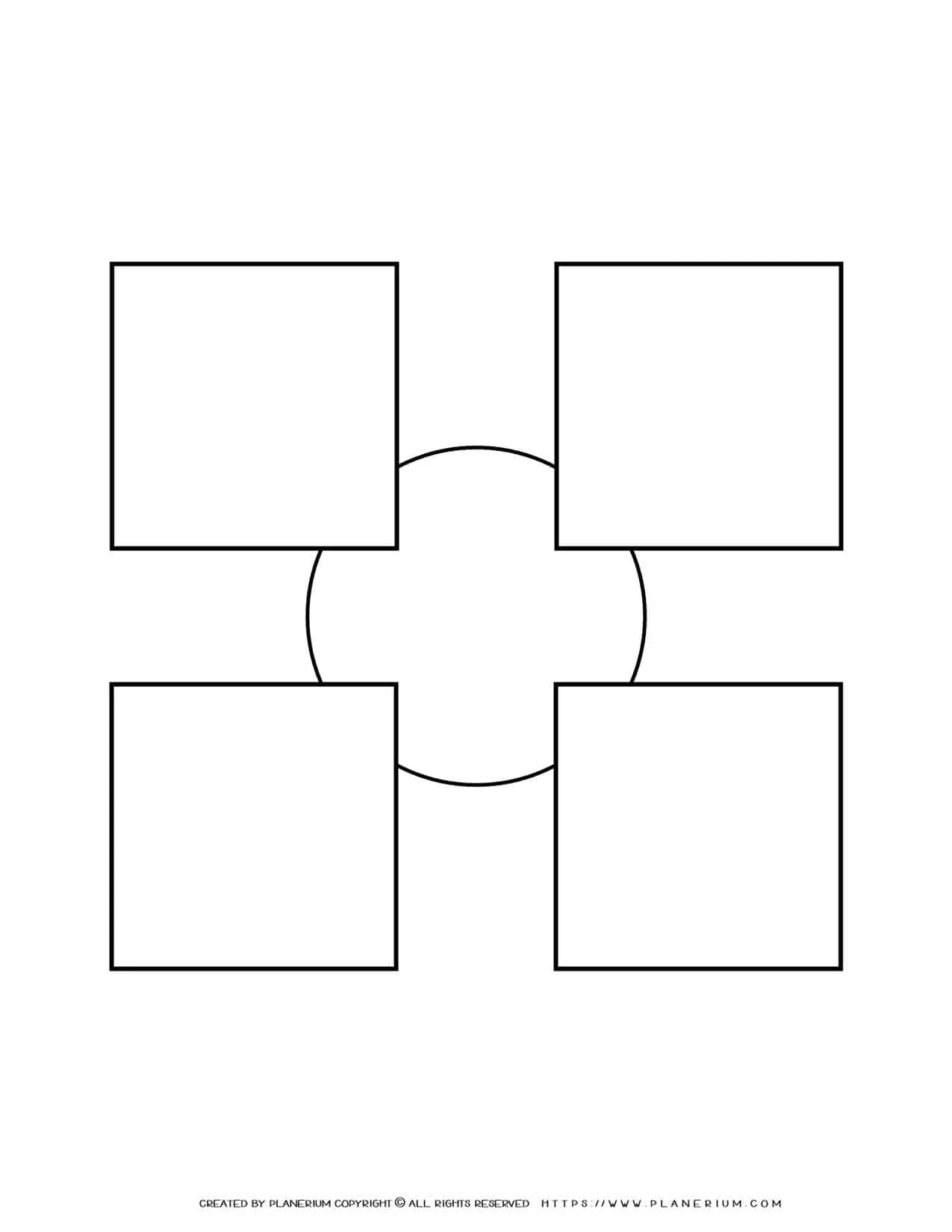
Sequence Chart Template – Four Squares on a Small Circle
1413
Views
29
Prints
6
Saves
Free printable four-part graphic organizer with four squares arranged around a small center circle. Use it to organize four key ideas, categories, steps, or details around one central topic in Grades 2-6.
Four-Step Sequence Chart – Free Printable Graphic Organizer
This free printable four-step sequence chart helps students organize events, steps, stages, or ideas in a clear visual order.
The template includes four large squares connected in a square-shaped path. The simple structure makes it useful for activities that can be broken into four main parts without overwhelming students with too many sections.
Students can add numbers, keywords, short sentences, symbols, or drawings to each square.
Classroom Ideas
Use this printable sequence organizer to help students:
- Sequence four events from a story
- Organize the beginning, middle events, and ending of a narrative
- Record four steps in a process
- Plan the stages of a classroom project
- Organize a simple procedure or set of instructions
- Sequence historical events
- Record stages in a science activity
- Retell information from a book, lesson, or video
- Organize a four-part routine
Suggested Grade Levels
This graphic organizer is especially useful for Grades 2-6.
The four-part structure is simple enough for younger elementary students while still being flexible for older students working with short processes, summaries, or project planning.
Teachers can add numbers, pictures, or short prompts before printing when students need additional guidance.
Why Use a Four-Step Sequence Organizer?
A four-step organizer helps students break information into a manageable sequence.
The limited number of sections encourages students to identify the most important events or stages rather than recording every detail.
This makes the template particularly useful for summarizing, sequencing, retelling, and planning.
The connected square layout also gives students a visual path to follow from one step to the next.
Ideas Across Subjects
Language Arts:
Sequence four important story events, retell a short narrative, or organize ideas before writing.
Science:
Record four stages in a process, experiment, observation, or simple scientific procedure.
Social Studies:
Sequence four historical events or organize important developments related to a topic.
Project-Based Learning:
Divide a project into four stages such as Plan / Research / Create / Share.
Classroom Routines:
Create a visual reminder for a four-step classroom procedure or independent work routine.
Explore More Graphic Organizers
Explore the full Graphic Organizer Templates collection for more free sequence charts, comparison templates, and visual thinking tools.
You may also find these templates useful:
- Four Squares on a Circle Sequence Chart – a related four-part layout with a circular visual structure.
- Four Squares and Four Circles Sequence Chart – useful when students need to connect main steps with additional details.
- Spiral Sequence Chart with 10 Circles – useful for longer sequences and processes with more stages.
- One-Column 7-Row Chart – a straightforward linear option for sequencing or listing information.
- Graphic Organizer Templates Collection – browse more layouts for organizing, comparing, sequencing, and planning information.
FAQ
What is a four-step sequence chart used for?
It helps students organize four events, stages, steps, or ideas in a clear visual order.
What grade levels is this printable suitable for?
It is especially useful for Grades 2-6. Teachers can add numbers, pictures, or prompts for students who need more support.
Can I use this organizer for story sequencing?
Yes. Students can use the four squares to record four important story events or retell a short narrative in order.
Can this chart be used for processes and procedures?
Yes. Each square can represent one step in a process, classroom routine, experiment, or project.
Can students draw instead of write?
Yes. The large squares work well for drawings, symbols, keywords, short sentences, or a combination of text and visuals.