
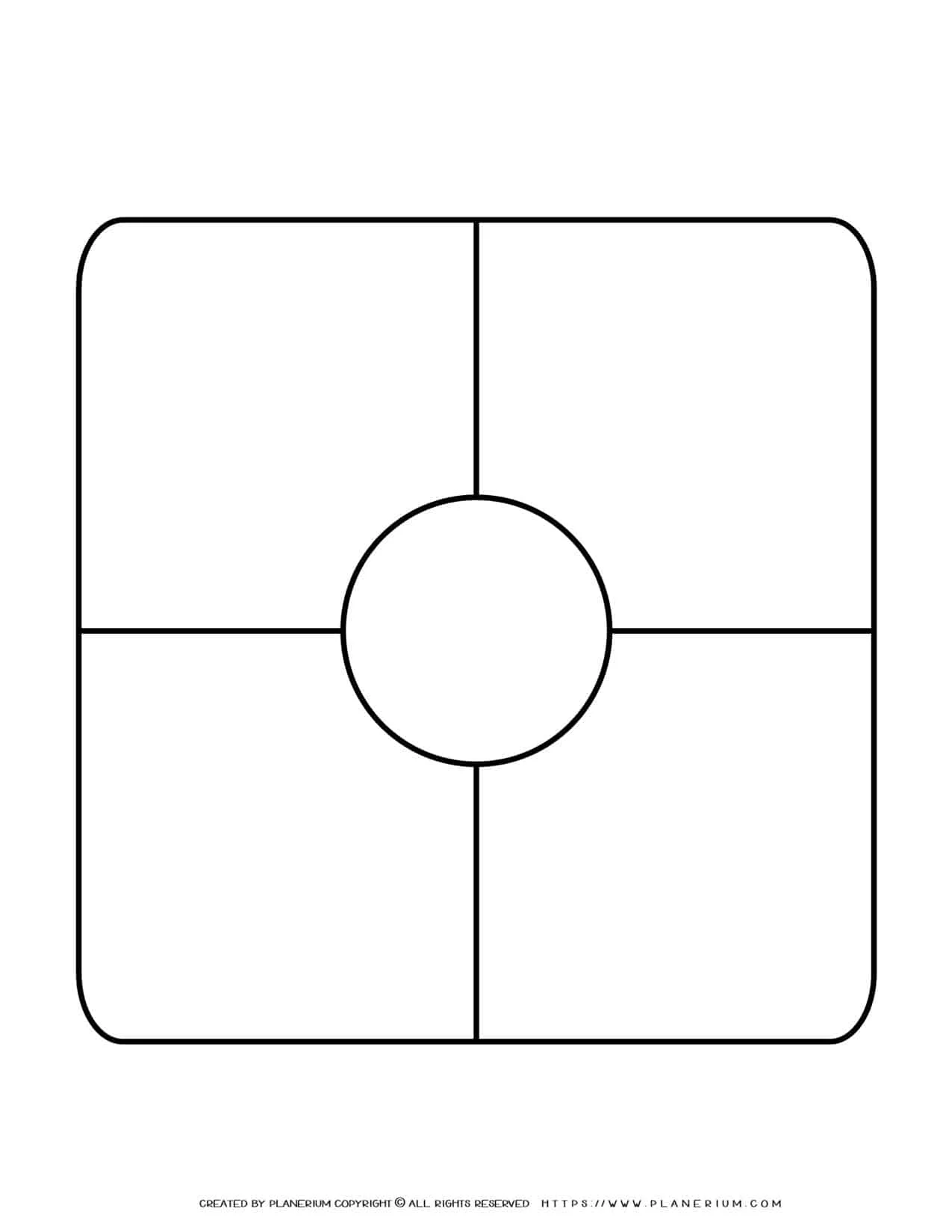
Story Map Template – Center Circle
1999
Views
188
Prints
14
Saves
Free printable story map and graphic organizer with a center circle and surrounding sections for organizing a main idea, story elements, supporting details, or related concepts. Suitable for Grades 2-6.
Story Map Template with Center Circle
This free printable story map and graphic organizer helps students organize one central idea and connect it to related details, story elements, or supporting information.
The template features a center circle surrounded by four larger sections, plus an additional square area. This flexible layout can be used for story planning, reading comprehension, concept mapping, research, and classroom discussions.
Students can use words, short sentences, keywords, symbols, or drawings depending on the activity.
Classroom Ideas
Use this printable organizer to help students:
- Plan the main idea and supporting details of a story
- Organize story elements such as character, setting, problem, and solution
- Record four key facts about one topic
- Summarize a text or lesson
- Organize ideas before writing
- Create a visual plan for a project
- Connect examples or evidence to one central concept
- Prepare ideas for a class discussion or presentation
- Organize research notes around one topic
Suggested Grade Levels
This graphic organizer is especially useful for Grades 2-6.
For younger students, teachers can place a picture, keyword, or short prompt in the center and use the surrounding sections for drawings or simple labels.
Older students can use the organizer independently for reading comprehension, writing preparation, research, and concept development.
How Can Students Use the Center Circle?
The center circle works well for the main idea, story title, topic, question, or central concept.
The surrounding sections can then hold related details, examples, events, evidence, or story elements.
The additional square area can be used flexibly for:
- A visual summary
- A conclusion
- A drawing
- A key quote
- A final idea
- A short written response
This makes the template more versatile than a traditional story map with fixed labels.
Ideas Across Subjects
Language Arts:
Place the story title or main idea in the center and use the surrounding sections for character, setting, problem, solution, events, or supporting details.
Reading Comprehension:
Use the center for the main idea and the surrounding areas for evidence, key details, examples, or important information from the text.
Science:
Place a scientific topic in the center and organize four related facts, properties, examples, or observations around it.
Social Studies:
Use the center for a person, place, event, or concept and organize related facts, causes, effects, or characteristics around it.
Writing:
Use the organizer before drafting to collect ideas and arrange supporting details around one central topic.
Explore More Graphic Organizers
Explore the full Graphic Organizer Templates collection for more free story maps, comparison charts, sequence organizers, and visual thinking templates.
You may also find these layouts useful:
- Five-Section Graphic Organizer with Headline – useful for organizing one main topic into five supporting ideas.
- Four Squares on a Small Circle – useful for connecting four supporting ideas to one central topic.
- Blank Three-Column Chart – useful for comparing or sorting information into three broad categories.
- 3-Column 6-Row Chart – useful for structured comparison and information gathering.
FAQ
What is a story map with a center circle used for?
It helps students organize a central idea, story topic, or concept and connect it to supporting details, events, examples, or story elements.
What should students write in the center circle?
The center can contain the story title, main idea, topic, question, character, or central concept.
What can the surrounding sections be used for?
They can hold story elements, supporting details, evidence, facts, examples, events, or related ideas.
What grade levels is this printable suitable for?
It is especially useful for Grades 2-6. Younger students can use drawings and short labels, while older students can add more detailed notes.
Can this organizer be used outside language arts?
Yes. The flexible layout works well for science, social studies, research, project planning, and other activities that involve one central topic with related information.
FAQ
Students place one central idea in the center circle and organize supporting details into the four surrounding areas, including a square for a visual or summary. This template practices visual-spatial planning, organization, attention to detail, creative design, fine motor control, and following directions.
It is especially useful for whole-class modeling and independent planning because it’s a quick-prep organizer that helps students plan before writing or discussion. Teachers can also generate a short lesson around the template with a lesson plan tool to save prep time.
Add teacher-created scaffolds around the square area, such as a pictorial cue, simplified prompts, or a checklist, to provide more structure. Model placing the main idea in the center and guide students to add related elements step-by-step so learners build planning skills.
Have students use the organized details from the four boxes and the square to write a short paragraph or give a brief oral summary, turning the visual plan into a written or spoken product. This deepens learning by moving from planning to composition or presentation.
Look for a clear main idea in the center, relevant supporting details in the surrounding areas, and an appropriate use of the square for a visual or summary to assess organization and following directions. Observe students during whole-class modeling or independent work to see attention to detail and planning skills in action.