
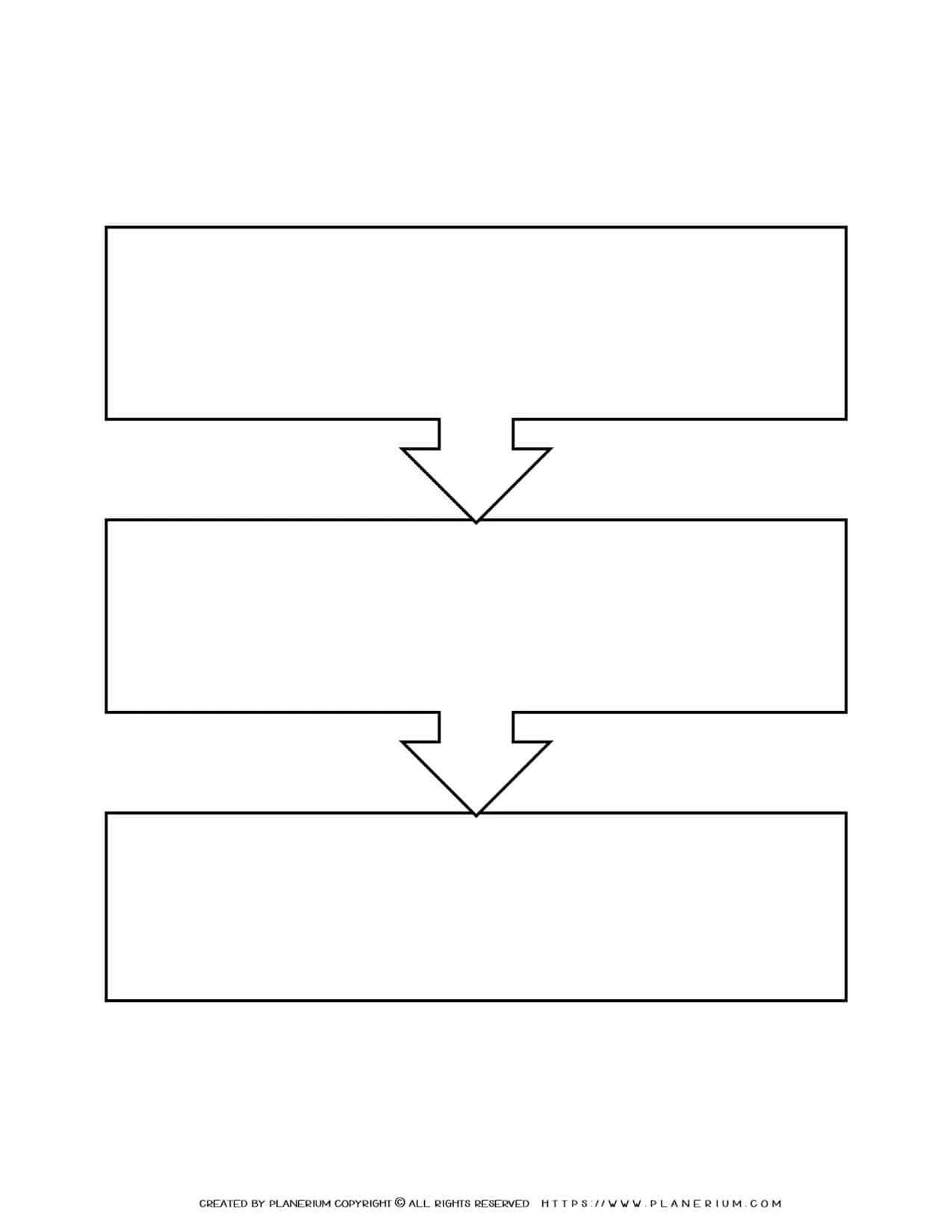
Story Map Template – Three Sections
1005
Views
10
Prints
17
Saves
Free printable 3-step sequence chart with connected boxes and arrows for organizing First / Next / Last, story events, simple processes, procedures, and classroom activities. Suitable for Grades 1-4.
Three-Step Sequence Chart – Free Printable Graphic Organizer
This free printable three-step sequence chart helps students organize information in a clear visual order from one step to the next.
The template includes three large rectangular sections connected with downward arrows. This simple structure makes it especially useful for activities that involve a clear progression, such as First / Next / Last, Beginning / Middle / End, short procedures, story events, and simple processes.
Students can use short sentences, keywords, drawings, symbols, or a combination of text and visuals in each section.
Classroom Ideas
Use this printable sequence organizer to help students:
- Organize First / Next / Last
- Sequence three important story events
- Show Beginning / Middle / End
- Record three steps in a simple process
- Organize a classroom procedure
- Retell a short story
- Explain how something happens step by step
- Sequence three historical or scientific events
- Plan a simple three-part writing activity
- Create a visual summary of a short lesson or text
Suggested Grade Levels
This graphic organizer is especially useful for Grades 1-4.
For younger students, teachers can add labels such as First / Next / Last or Beginning / Middle / End before printing.
Students can respond with drawings, single words, or short sentences depending on their reading and writing level.
Older students can use the same structure for concise sequencing, short summaries, procedures, and planning.
Why Use a Three-Step Sequence Organizer?
A three-step structure helps students focus on the most important parts of a process or sequence.
The arrows make the direction clear and help students understand how one stage leads to the next.
This makes the organizer particularly useful for:
- Sequencing events
- Understanding order
- Retelling
- Following procedures
- Planning
- Summarizing short processes
The simple layout keeps the activity focused and easy to follow.
Ideas Across Subjects
Language Arts:
Sequence three story events, organize Beginning / Middle / End, or plan a short narrative.
Reading Comprehension:
Use the three boxes to identify what happened first, next, and last in a text.
Science:
Record three stages in a simple process, experiment, observation, or change over time.
Social Studies:
Sequence three historical events or developments in chronological order.
Writing:
Use the boxes to plan a three-part response, short story, explanation, or procedure.
Classroom Routines:
Create a visual three-step routine or set of instructions for independent work.
Explore More Graphic Organizers
Explore the full Graphic Organizer Templates collection for more free sequence charts, story maps, comparison templates, and visual thinking tools.
You may also find these templates useful:
- Four Squares on a Square Sequence Chart – useful when students need a four-step sequence.
- Four Circles on a Circle with Arrows – useful for four-step cycles and repeating processes.
- One-Column 7-Row Chart – useful for longer linear sequences.
- Story Map with Center Circle – useful when students need to connect a central idea with several supporting details.
FAQ
What is a three-step sequence chart used for?
It helps students organize three events, stages, steps, or ideas in a clear order.
Can I use this for First / Next / Last activities?
Yes. The three connected boxes are ideal for simple First / Next / Last sequencing activities.
Can it also be used for Beginning / Middle / End?
Yes. Teachers can label the three sections Beginning, Middle, and End for story retelling or narrative planning.
What grade levels is this printable suitable for?
It is especially suitable for Grades 1-4. Younger students can use drawings or short labels, while older students can add short written responses.
Why are there arrows between the sections?
The arrows provide a clear visual direction and help students understand how one step or event leads to the next.
Can this organizer be used outside language arts?
Yes. It works well for science processes, social studies timelines, classroom procedures, and any activity with three ordered steps.
FAQ
It helps students plan and organize story parts across three un‑labeled rows, practicing textual and visual organization, visual‑spatial planning, attention to detail, fine motor control, and creative design.
Use the three‑section layout for quick routine activities like independent planning or short practice tasks because the minimal‑prep template supports spatial planning and keeps teacher prep low.
Provide teacher‑added scaffolds (for example, a word bank or sentence starters) above specific rows so learners practice textual and visual organization at varied levels while you keep the core three‑section structure intact.
Have students expand one or more rows into fuller written descriptions or more detailed illustrations to deepen practice in textual organization, visual design, and attention to detail.
Use the three sections as a quick formative check to see how students separate and sequence story parts; use observed strengths or gaps to plan targeted follow‑up lessons or generate a short lesson outline with the Lesson Plan Generator.